
Pep talk - January 2026

Qkine Limited and Akron Bio announce strategic partnership
Collaboration to Deliver High-Quality Cytokines and Growth Factors to Enable the Advancement of Stem Cell-Based Therapeutics
We’re excited to announce our new partnership with Akron Bio, a leading supplier of critical materials and services to the cell and gene therapy industry.
This strategic partnership will focus on the joint development and global supply of ancillary materials to enable the development of stem cell-based therapeutics.
Combining Qkine’s proprietary growth factor and cytokine technologies with Akron’s established GMP manufacturing capabilities and long-standing focus on providing solutions to cell and gene therapy developers. Together, we will accelerate the development and delivery of innovative, high-performance recombinant proteins essential for stem cell expansion, differentiation, and maturation, addressing the need for reliable, consistent, and scalable solutions in the rapidly evolving field of regenerative medicine.
Qkine’s hematopoietic growth factors and cytokines critical for the manufacture of stem cell-based therapeutics will be made available globally and exclusively through Akron’s commercial channels, thereby providing security of supply to innovators. Moreover, the two companies will partner to develop next-generation products aimed at supporting the automated production of cell therapies, thereby enabling greater access to these life-saving treatments.


Generation of a Full Thickness Human Skin Equivalent Using Alvetex® Scaffold and Qkine Growth Factor Supplements
A collaborative study between Durham University, REPROCELL Europe and Qkine
This application note describes a collaborative study between REPROCELL Europe, Durham University and Qkine, designed to evaluate the combined application of REPROCELL’s Alvetex® Scaffold Technology and Qkine high-purity recombinant growth factors optimal skin model generation and reproducibility.
This application note uses:
- Qkine animal origin-free recombinant human TGF-β1 PLUS™ protein (Qk010)
- Qkine high purity recombinant human KGF (FGF-7) protein (Qk046)
Read and download the full application note

Buy online, contact our team or request a quote.
Did you miss?
Refined and benchmarked homemade media for cost-effective, weekend-free human pluripotent stem cell culture
In this recently revised and expanded paper from our collaborators in the Bertero lab, Truszkowski et al. have described a cost-effective homemade media recipe for the culture of human pluripotent stem cells (hPSCs), taken with our recent application note [Commercial versus in-house media: a comparative study of human induced pluripotent stem cell maintenance] this adds to the evidence that homemade media using Qkine growth factors can be a suitable replacement for, or improvement on, commercially available media. The high cost of commercially available proprietary media and lack of transparency and flexibility can be a problem for academic labs and translational labs looking at scaling iPSC protocols.
Application note: Commercial versus in-house media: A comparative study of human induced pluripotent stem cell maintenance
Since their initial description, human iPSCs have transformed biomedical research by enabling patient-specific disease modeling and providing a renewable source of cells for drug screening and regenerative therapies. The maintenance of iPSCs in an undifferentiated and genetically stable state demands culture conditions that accurately replicate essential signaling environments while minimizing the use of undefined components. Early feeder-dependent systems relying on mouse embryonic fibroblasts have largely been replaced by feeder-free, chemically defined media, reducing variability and enhancing clinical applicability.
This application note directly compares the performance of selected commercially available iPSC media with in-house formulations. Key parameters assessed include cell morphology and proliferation rate. By systematically evaluating both types of media, we aim to provide practical insights for laboratories seeking to balance cost, performance, and experimental reproducibility in human iPSC culture systems.
New application note series: Stability of Qkine growth factors
Qkine manufactures high-purity, animal origin-free growth factors, cytokines and other complex proteins for life science applications including stem cell and organoid culture. Qkine is committed to sustainability in science and as part of this commitment we ship our proteins lyophilized and at ambient temperature. With shipping around the world becoming more complex, we’ve performed a series of tests to reassure our customers of the stability of our growth factors over an extended period.
In addition, recombinant growth factors and cytokines are essential components in the successful culture of stem cells and organoids for translational research. To preserve pluripotency, stem cells require exposure to consistent levels of specific growth factors and cytokines. The instability of recombinant protein media components can increase the need for frequent media changes to preserve cell conditions and this is costly.
We have developed a series of application notes to determine the stability of Qkine growth factors both in their lyophilized forms at various temperatures and storage times and once reconstituted in buffer or media at various temperatures.

Lyophilized TGF-β1 PLUS™ bioactivity remained stable for 14 days. Bioactivity was determined using a TGF-β1-responsive (CAGA) firefly luciferase reporter in transiently transfected HEK293T cells. Cells were treated in triplicate for 6 hours with a serial dilution of TGF-β1 PLUS™ (Qk010). (A) Stored at room temperature (RT, EC50 66.20 pg/ml) or -80 °C (control, EC50 72.59 pg/ml). (B) Stored at room temperature with freeze thaws (RT/FT, EC50 53.27 pg/ml) or -80°C (control, EC50 57.29 pg/ml). Firefly luciferase activity was measured and normalized. Data from Qk010 lot #204762.
Qkine lyophilized proteins are stable, bioactive and sterile after > 2 years storage in freezer
Qkine manufactures high-purity, animal origin-free growth factors, cytokines and other complex proteins for life science applications including stem cell and organoid culture. We’ve performed a series of tests to reassure our customers of the stability of our growth factors over an extended period at -80 °C and to show that there is no difference in quality between older and newer lots. In this application note we validate the stability and bioactivity of selected lyophilized proteins stored at -80 °C for > 2 years; activin A (Qk001), TGF-β1 PLUSTM (Qk010), Flt3L (Qk087), TGF-β3 (Qk054) and FGF-2 145 aa (Qk025). Full application note.
Qkine proteins are stable and bioactive after 14 days at room temperature and multiple freeze-thaws
Qkine is committed to sustainability in science and as part of this commitment we ship our proteins lyophilized and at ambient temperature. With shipping around the world becoming more complex, we’ve performed a series of tests to reassure our customers of the stability of our growth factors over an extended period. In this application note we validate the stability and bioactivity of selected lyophilized proteins; FGF-2 145 aa (Qk025), TGF-β1 PLUSTM (Qk010), IL-2 (Qk089) and Flt3L (Qk087), stored at room temperature or subjected to 4 freeze-thaw cycles, alternating between room temperature and -80 °C for 14 days. Full application note.
Qkine reconstituted growth factors and cytokines exhibit excellent stability under recommended storage conditions
Generally, growth factors and cytokines are most stable in their lyophilized (freeze-dried) form. All Qkine proteins are shipped lyophilized, and we guarantee their stability for at least two years when stored at -20°C or -80°C in this form. However, we are frequently asked how stable our proteins are once reconstituted and stored at different concentrations and in different buffers, including cell culture media. In this application note, we address these questions using TGF-beta family growth factors: activin A (Qk001), TGF-β1 (Qk010), GDNF (Qk051) and BMP-4 (Qk038). Full application note.
Stability of Qkine recombinant growth factors and cytokines in conditioned media
FGF-2 is a key component of stem cell media, it is known to be unstable under cell culture conditions, leading to the necessity for daily media changes to maintain culture conditions for stem cell culture. Although the thermo-instability of FGF-2 is well documented, the thermostability of other essential growth factors has not been investigated. This application note reviews the stability of Qkine growth factors (GM-CSF, IL-6, IGF-1, IGF1 LR3, GDNF, BMP-4, HGF NK1 and TGF-ß1 PLUS) under cell culture-like conditions to ensure maximum cost effectiveness and reproducibility in stem cell cultures. Full application note.
New differentiation kits
At Qkine we believe in transparency, but we also believe in convenience and saving money! Our differentiation kits contain everything you need for complex differentiations of PSC into mature cell types. No secrecy, just 30-40% saving on individual list prices.
Paired with our extensive range of application notes using the kits for full knowledge sharing and validation.
We're always happy to collaborate so if you think something is missing, let us know!
Microglial differentiation kit (Qk519)

Human BMP-4 - Qk038 - 25 µg
Used for differentiation of mesenchymal cells to adipocytes, epithelial cancer EMT, and regulating neuronal and glial cell development.
FGF2-G3 145 aa - Qk052 - 50 µg
A thermostable engineered form of FGF-2. FGF2-G3 145 aa is the 145 aa active domain of FGF-2 with the functional half-life increased from <10 h (wild-type) to >7 days (FGF2-G3).
Human Flt3L - Qk087 - 25 µg
Stimulates the survival, proliferation, and differentiation of various early myeloid and lymphoid progenitor cells. Flt3L is commonly used in the differentiation of hematopoietic stem cells into dendritic cells.
Human GM-CSF - Qk076 - 25 µg
Commonly used in cell culture to stimulate the differentiation and maturation of human-induced pluripotent stem cells or peripheral blood monocytes to myeloid cells.
Human M-CSF - Qk075 - 25 µg
Used in vitro for the differentiation of human induced pluripotent stem cell (iPSC)-derived macrophages as well as the maintenance and development of monocytes in hematopoietic stem cell culture.
Human IL-3 – Qk090 - 25 µg
Stimulate the differentiation and maturation of human induced pluripotent stem cells towards mast cells, basophils, neutrophils, eosinophils, monocytes, and megakaryocytes.
Human IL-34 PLUS™ – Qk091 - 25 µg
Plays a key role for the development and maintenance of tissue-resident macrophages such as Langerhans cells in the skin and microglia in the brain.
Human SCF - Qk078 - 25 µg
Qkine has optimized the SCF manufacture process to produce a highly bioactive protein with excellent lot-to-lot consistency for enhanced experimental reproducibility.
Human TPO – Qk098 - 25 µg
Thrombopoietin (TPO) is a cytokine which stimulates the production and differentiation of megakaryocytes, regulating platelet production.
Human VEGF – Qk048 - 25 µg
VEGF 165 is commonly used with human-induced pluripotent stem cells or embryonic stem cells-derived endothelial cells for developing human vascular tissue models.
Astrocyte differentiation kit (Qk520)

Human noggin - Qk034 - 50 µg
Noggin is used in the culture of intestinal, pancreatic, lung and tumor-derived organoids and the maintenance of undifferentiated embryonic stem cells (ESC) and for stem cell differentiation into neural and microglial lineages.
FGF2-G3 145 aa - Qk052 - 50 µg
A thermostable engineered form of FGF-2. FGF2-G3 145 aa is the 145 aa active domain of FGF-2 with the functional half-life increased from <10 h (wild-type) to >7 days (FGF2-G3).
Human EGF – Qk011 - 100 µg
Potent EGF-family growth factor used in many human and mouse organoid and stem cell culture systems including intestinal and tumor organoid culture.
Human CNTF - Qk063 - 25 µg
Used to culture primary neurons and glial cells such as astrocytes and Schwann cells. It is also used to culture retinal cells and adipocytes.
What's new?
Recombinant human activin B protein (Qk024)
Activin B is a member of the transforming growth factor-beta (TGF-β) superfamily, a group of proteins that play key roles in regulating cell growth, survival and differentiation. Activin B has been shown to play a role in metabolism, tissue regeneration and fibrosis. Recombinant activin B has been used to induce pancreatic differentiation and induce wound healing in mesenchymal stem cells (MSCs).
Qkine recombinant activin B is the only commercially available animal origin-free activin B protein. Recombinant activin B is a bioactive 25.6 kDa homodimer, tag free and carrier free for improved reproducibility.

Recombinant activin B activity was determined using a Smad reporter assay in HEK293 cells co-transfected with the activin B co-receptor ALK7. HEK293 cells were treated in triplicate with a serial dilution of activin B for 6 hours. Firefly activity was measured and normalized to the control Renilla luciferase activity. Data from Qk024 lot #204803. EC50 = 0.34 ng/ml (13 pM).
Recombinant human activin C protein (Qk026)
Activin C is a member of the transforming growth factor-beta (TGF-β) superfamily, a group of proteins that play key roles in regulating cell growth, survival and differentiation. Activin C activates SMAD2/3 signaling and is highly expressed in liver, testis and prostate.
Qkine recombinant activin C is the only commercially available animal origin-free activin C protein. Recombinant activin C is a bioactive 25 kDa homodimer, tag free and carrier free for improved reproducibility.

Recombinant activin C activity was determined using a Smad reporter assay in HEK293 cells co-transfected with the activin C co-receptor ALK7. HEK293 cells were treated in triplicate with a serial dilution of activin C for 6 hours. Firefly activity was measured and normalized to the control Renilla luciferase activity. Data from Qk026 lot #204801. EC50 = 0.63 ng/ml (25 pM).
Recombinant human BDNF protein (Qk050-CTG)
Brain-derived neurotrophic factor (BDNF) is a member of neurotrophin family and plays a crucial role in neural development, maintenance, and function. It stimulates neurogenesis and is also a major regulator of synaptic plasticity and neuroprotection. BDNF is essential for neuronal maintenance and differentiation for neural regenerative stem cell therapies.
Cell therapy grade BDNF protein has a molecular weight of 14 kDa, animal origin-free, carrier-free, tag-free, and non-glycosylated to ensure its purity with exceptional lot-to-lot consistency.
Qkine cell therapy grade high purity animal origin-free proteins are manufactured as GMP grade equivalents in an ISO 9001:2015-certified facility, under ISO 20399:2022 standards with GMP compliance, defined quality criteria and documentation.

Qkine BDNF was as bioactive as the WHO (NIBSC) standard BDNF. BDNF activity was determined using a NFAT luciferase reporter assay in transiently transfected HEK293 cells also expressing TrkB. Transfected cells were treated in triplicate with a serial dilution of BDNF for 6 hours. Firefly activity was measured and normalized to the control Renilla luciferase activity. Qk050 #204714 EC50 = 1.46 ng/ml (104 pM). WHO (NIBSC) EC50 = 1.36 ng/ml.
Technotes
At Qkine data transparency is our promise. We test all new products against others on the market to ensure each is as bioactive or more, only then will they be approved for sale.
Each new lot is tested to ensure the bioactivity is consistent lot-to-lot, to ensure the most consistent cell cultures and assays. All data is available for all lots, and many are available as technotes.
Why not see if data on your protein of interest is available (if not ask!)
Technote | G-CSF (Qk074)
Get 80% off our high bioactivity G-CSF until 31st March 2026 in our flash sale!
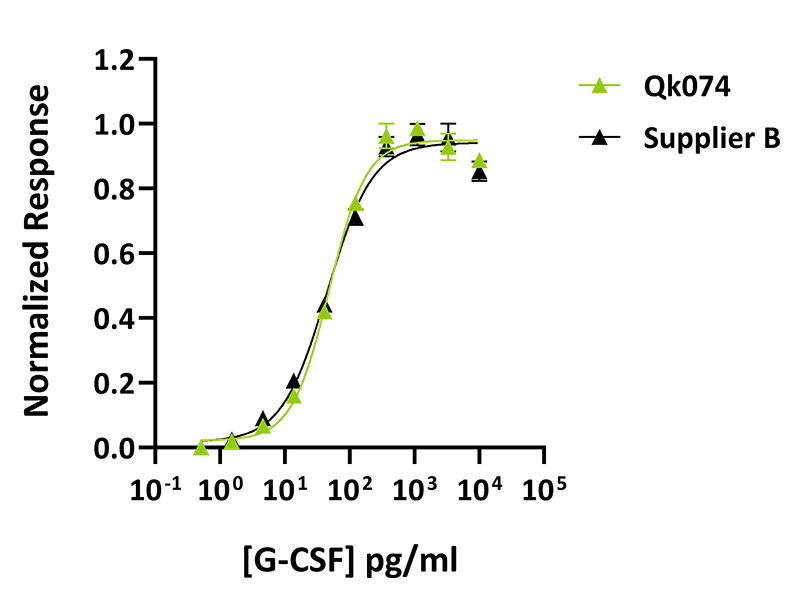
Qkine G-CSF was as biologically active as a comparable supplier protein. Recombinant G-CSF activity was determined using the Promega CellTiter-Glo luminescent cell viability assay. NFS-60 mouse myeloid leukemia cells were treated in triplicate with a serial dilution of Qkine G-CSF (Qk074, green) or Peprotech G-CSF (Supplier B, black) for 48 hours. Cell viability was measured and normalized. Data from Qk074 lot #204487.
Technote | IL-18 (Qk100)
Get 60% off our high bioactivity IL-18 until 31st March 2026 in our flash sale!

Qkine IL-18 was as bioactive as IL-18 from an alternative supplier. Recombinant IL-18 activity was determined using the Promega serum response element luciferase reporter assay in transfected HEK293T cells, co-transfected with IL-18R alpha. Cells were treated in triplicate with a serial dilution of Qkine IL-18 (Qk100, green) or alternative supplier IL-18 (R&D Systems, 9124-IL-010/CF, Supplier A, black) for 6 hours. Firefly activity was measured and normalized to the control Renilla luciferase activity. Data from Qk100 lot #204753.
Recent publications
Simplified In Vitro Generation of Human Gastruloids for Modelling Early Development
Targeting cancer glutamine dependency with a first-in-class inhibitor of the mitochondrial glutamine transporter SLC1A5_var
All our growth factors are manufactured within a stringent quality framework, ensuring high-quality proteins that maintain robust, reproducible, and physiologically relevant stem cell and organoid cultures that adhere to our Nine-point Quality Commitment.
Upcoming Events
-
- UK Organoid & Organ-on-a-Chip Society Launch Event | 3 February 2026 | Cambridge, UK
- World Organoid & Organ-on-a-chip Research Day 2026 | 4-5 February 2026 | Cambridge, UK
- Advanced Therapies Week 2026 | 9-12 February 2026 | San Diego, USA
- Bioreactors and Growth Environments for Tissue Engineering Workshop 2026 | 5-6 March 2026 | Keele, UK
We'd always love to meet you at any of events, contact support@qkine.com to make an appointment.
What’s next?
Qkine are committed to producing the most high quality and bioactive growth factors and cytokines, coming soon to our extensive portfolio:
-
Recombinant human nodal protein (Qk029) - Expected February 2026
-
Recombinant human BMP-7 protein (Qk028) - Expected April 2026
- Recombinant human activin A/B protein (Qk127) - Expected April 2026
- Recombinant human activin A/C protein (Qk128) - Expected May 2026
If you wish to be notified when proteins are released, contact us customerservice@qkine.com