
Qkine reconstituted growth factors and cytokines exhibit excellent stability under recommended storage conditions
Kerry Price, Elayne Jardim
Qkine
Why is growth factor stability important?
Recombinant growth factors and cytokines are essential components in the successful culture of stem cells for translational research and the development of cellular agriculture. To preserve pluripotency, stem cells require exposure to defined concentrations of specific growth factors and cytokines. When making cell culture media, it is important to know exactly how much growth factor you are adding, and to be sure that it has not lost activity after a period of storage.
Does growth factor buffer formulation and storage temperature affect stability?
Generally, growth factors and cytokines are most stable in their lyophilized (freeze-dried) form. All Qkine proteins are shipped lyophilized, and we guarantee their stability for at least two years when stored at -20°C or -80°C in this form. However, we are frequently asked how stable our proteins are once reconstituted and stored at different concentrations and in different buffers, including cell culture media. In this application note, we address these questions.
Methods
TGF-β family growth factors: activin A (Qk001), TGF-β1 (Qk010), GDNF (Qk051) and BMP-4 (Qk038), were tested for bioactivity before and after storage under commonly used conditions. They were stored either in the freezer (at -20 °C) or in the fridge (4 °C) at 50 µg/ml in PBS + 0.1% BSA, or in the fridge at 1 µg/ml in cell culture media (DMEM + 10% FBS). After one month, we performed bioactivity assays to compare the activity of the test protein dilutions to the activity of proteins stored lyophilized at -80 °C and freshly reconstituted as recommended.
Results
All Qkine growth factors tested remained stable and retained their bioactivity when reconstituted and stored under standard conditions for growth factor aliquots (50 µg/ml in PBS + 0.1% BSA, -20 °C). When these aliquots were stored at 4 °C or further diluted in cell culture media to 1 µg/ml and stored in the fridge for one month, the EC50s were unaltered. There were <2-fold differences in EC50s for each comparison, indicating that all the proteins tested are stable when stored in these buffers and at these temperatures.
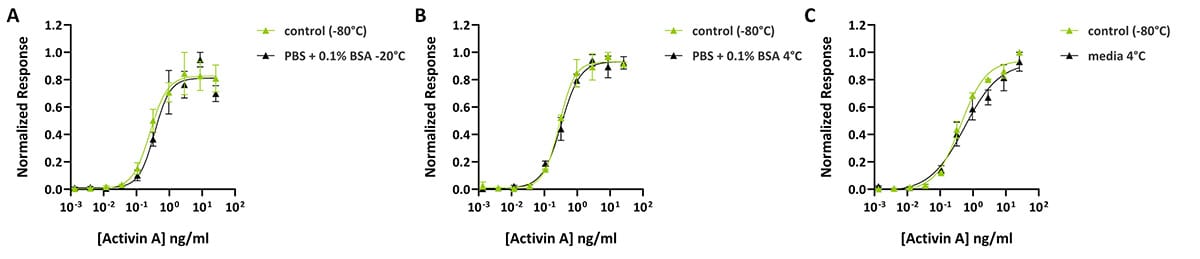
Figure 1. Activin A remained bioactive under all storage conditions. Bioactivity was determined using a CAGA reporter luciferase assay; transfected HEK293T cells were treated in triplicate with a serial dilution of activin A (Qk001) which had been reconstituted and stored for one month under the conditions indicated. Firefly luciferase activity was measured and normalized to control Renilla luciferase activity. (A) Bioactivity of control activin A (freshly reconstituted and diluted from protein stored lyophilized at -80 °C; EC50 = 0.26 ng/ml) compared with protein stored in PBS + 0.1% BSA at -20 °C for one month (EC50 = 0.36 ng/ml). (B) Bioactivity of a control protein (EC50 = 0.28 ng/ml) compared with protein stored in PBS + 0.1% BSA at 4 °C for one month (EC50 = 0.32 ng/ml). (C) Bioactivity of control protein (EC50 = 0.42 ng/ml) compared with protein stored in cell culture medium at 4 °C for one month (EC50 = 0.56 ng/ml).
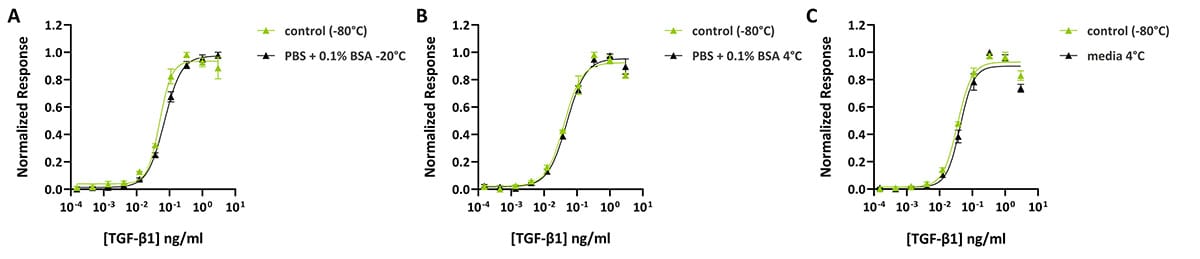
Figure 2. TGF-β1 remained bioactive under all storage conditions. Bioactivity was determined using a CAGA reporter luciferase assay; transfected HEK293T cells were treated in triplicate with a serial dilution of TGF-β1 (Qk010) which had been reconstituted and stored under the conditions indicated. Firefly luciferase activity was measured and normalized to control Renilla luciferase activity. (A) Bioactivity of a control TGF-β1 (freshly reconstituted; EC50 = 0.050 ng/ml) compared with TGF-β1 stored in PBS + 0.1% BSA at -20 °C for one month (EC50 = 0.070 ng/ml). (B) Bioactivity of control (EC50 = 0.040 ng/ml) compared with protein stored in PBS + 0.1% BSA at 4 °C for one month (EC50 = 0.049 ng/ml). (C) Bioactivity of control (EC50 = 0.035 ng/ml) compared with protein stored in cell culture medium at 4 °C for one month (EC50 = 0.043 ng/ml).
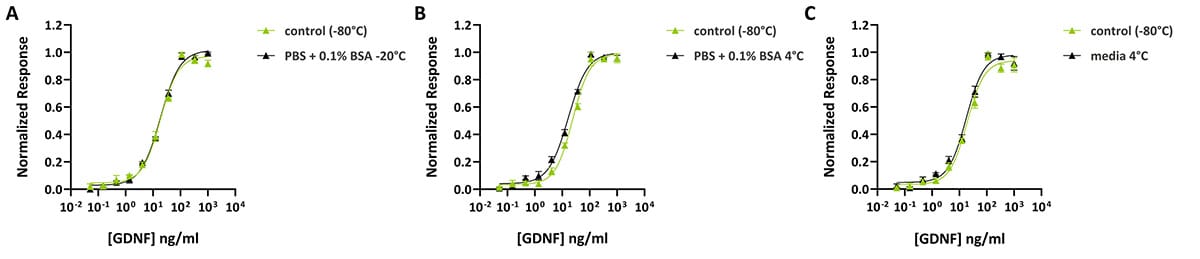
Figure 3. GDNF remained bioactive under all storage conditions. Bioactivity was determined using an SH-SY5Y cell proliferation assay; cells were incubated with different concentrations of GDNF (Qk051) in the presence of retinoic acid and recombinant GFR α1 for 3 days before viable cell measurement using an MTS assay. (A) Bioactivity of control GDNF (freshly reconstituted; EC50 = 18.5 ng/ml) compared with protein stored in PBS + 0.1% BSA at -20 °C for one month (EC50 = 18.7 ng/ml). (B) Bioactivity of a control GDNF (EC50 = 24.1 ng/ml) compared with protein stored in PBS + 0.1% BSA at 4 °C for one month (EC50 = 16.5 ng/ml). (C) Bioactivity of a control GDNF (EC50 = 19.1 ng/ml) compared with protein stored in cell culture medium at 4 °C for one month (EC50 = 17.6 ng/ml).
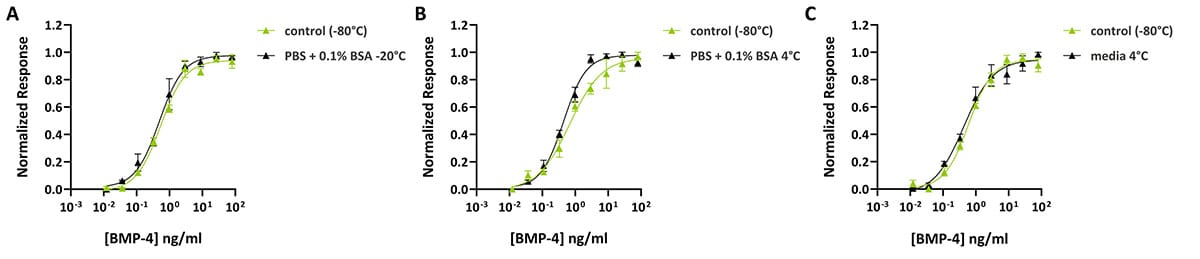
Figure 4. BMP-4 remained bioactive under all storage conditions. Bioactivity was determined using a BRE reporter luciferase assay; transfected HEK293T cells were treated in triplicate with a serial dilution of BMP-4 (Qk038) which had been reconstituted and stored under the conditions indicated. Firefly luciferase activity was measured and normalized to control Renilla luciferase activity. (A) Bioactivity of control BMP-4 (freshly reconstituted; EC50 = 0.54 ng/ml) compared with protein stored in PBS + 0.1% BSA at -20 °C for one month (EC50 = 0.49 ng/ml). (B) Bioactivity of a control BMP-4 (EC50 = 0.68 ng/ml) compared with protein stored in PBS + 0.1% BSA at 4 °C for one month (EC50 = 0.44 ng/ml). (C) Bioactivity of a control BMP-4 (EC50 = 0.61 ng/ml) compared with protein stored in cell culture medium at 4 °C for one month (EC50 = 0.43 ng/ml).
What does this mean for my reconstituted growth factor?
The results show that there is no decline in activity when our proteins are stored under these conditions for at least one month.
We recommend reconstituting your protein at 1 mg/ml, and then, for long term use, diluting to the required concentration in your chosen buffer with carrier protein. If freezing, we recommend preparing single-use aliquots to avoid repeated freeze-thaw cycles.
Further Information
Qkine growth factors are manufactured to the highest of quality standards and are free from animal-derived contaminants, delivering low endotoxicity and high purity. At Qkine, we are committed to raising the standards of growth factors, cytokines and related proteins to better support long-term and complex neural stem cell culture. We are a science-led team, please reach out with any questions or requests to [email protected].
All our recombinant proteins are animal-free and come with Bioactivity. Guaranteed.
Contact us
Our science team is here to help, please contact us if you have any questions.