
 Powered by Bioz
 Recombinant human IL-34 PLUS™ protein (Qk091)
 Price range: £350.00 through £4,500.00View product
Price range: £350.00 through £4,500.00
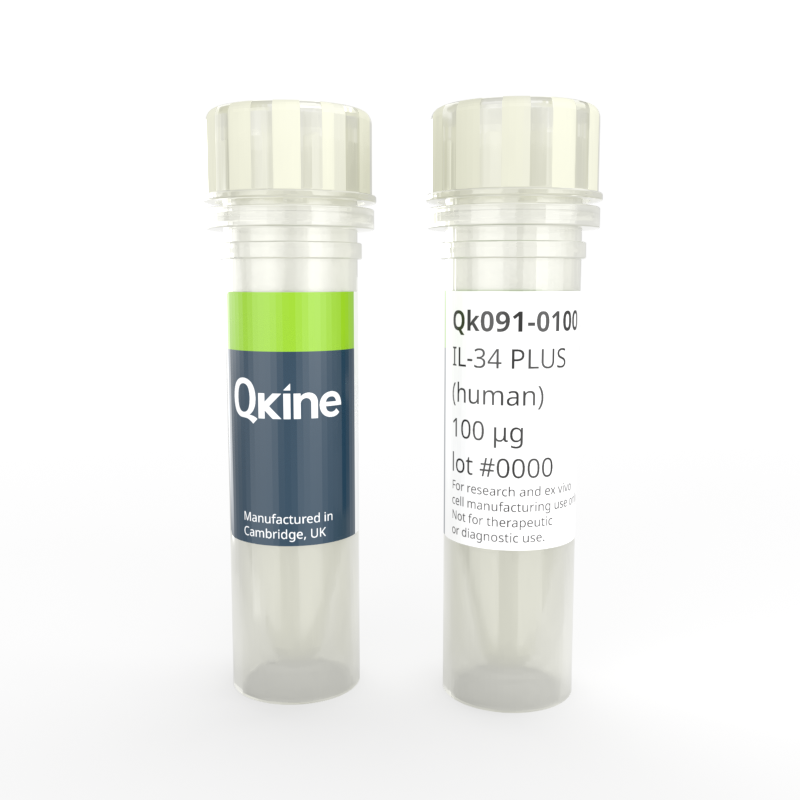


Interleukin-34 (IL-34) is a cytokine involved in regulating the differentiation, survival, and activation of monocytes, macrophages, and osteoclasts. IL-34 plays a key role for the development and maintenance of tissue-resident macrophages such as Langerhans cells in the skin and microglia in the brain. Recombinant IL-34 can be used in the differentiation of induced pluripotent stem cells (iPSC) to microglia.
Qkine have optimized the sequence and manufacture of IL-34 PLUS™ to produce a highly and consistently bioactive protein (patent pending GB 2514413.0). Qk091 has a molecular weight of 25 kDa as a monomer and is supplied as a non-covalent dimer, highly pure, animal origin-free, tag free and carrier free for reproducible microglial differentiation and immune cell culture.
This protein is also available as GMP compliant Cell Therapy Grade, to enquire email [email protected].
In stock
Orders are typically shipped same or next day (except Friday).
Easy world-wide ordering, direct or through our distributors.
Price range: £350.00 through £4,500.00
Buy online with secure credit card or purchase order. For any questions, please email [email protected]
>98%, by SDS-PAGE quantitative densitometry
Animal origin-free (AOF) and carrier protein-free
Expressed in E. coli
Manufactured in our Cambridge, UK laboratories
Lyophilized from acetonitrile, TFA
Polarization of anti-inflammatory or M2 macrophage
Generation of iPSC-derived microglia and Langerhans cells
Osteoclast culture to study osteoporosis and bone disorders
Recombinant IL-34 PLUS™ activity was determined using an SRE reporter assay in HEK293 cells co-transfected with the CSF1R receptor. Transfected HEK293 cells were treated in triplicate with a serial dilution of IL-34 for 3 hours. Firefly activity was measured and normalized to the control Renilla luciferase activity. Data from Qk091 lot #204768. EC50 = 8.4 ng/ml (0.33 nM).
Recombinant IL-34 PLUS™ migrates as a major band at approximately 27 kDa (monomer) in reduced (R) and at approximately 25 kDa in non-reduced (NR) conditions. No contaminating protein bands are present. The purified recombinant protein (3 µg) was resolved using 15% w/v SDS-PAGE in reduced (+β-mercaptoethanol, R) and non-reduced (NR) conditions and stained with Coomassie Brilliant Blue R250. Data from Qk091 lot #204768.
Mass spectrometry: single species with expected mass
Recovery from stock vial: >95%
Endotoxin: <0.05 EU/μg protein
We are a company founded and run by scientists to provide a service and support innovation in stem cell biology and regenerative medicine. All our products are exceptionally high purity, with complete characterisation and bioactivity analysis on every lot.
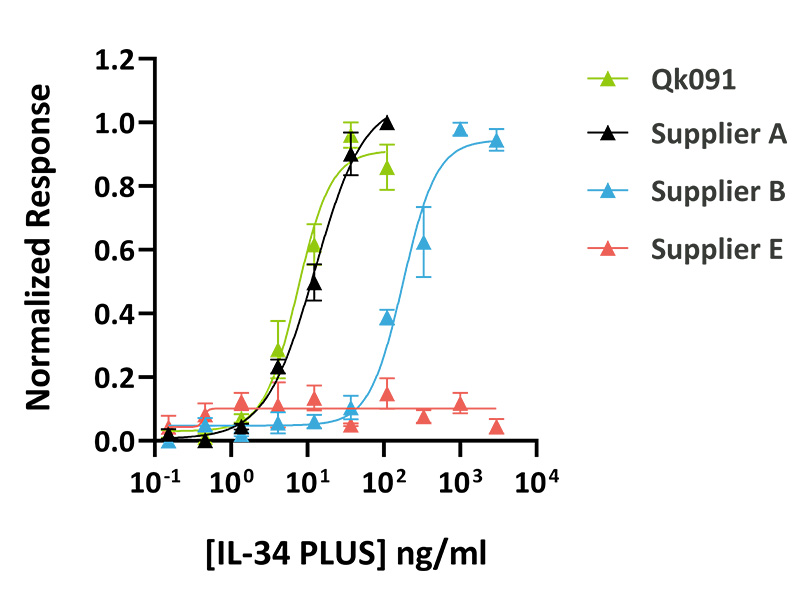
Qkine animal origin-free IL-34 PLUS™ was as bioactive as a mammalian cell-expressed IL-34 from an alternative supplier. IL-34 activity was determined using an SRE reporter assay in HEK293 cells co-transfected with the CSF1R receptor. Transfected HEK293 cells were treated in triplicate with a serial dilution of Qkine IL-34 PLUS™ (Qk091, green), mammalian cell-expressed IL-34 (Supplier A, black) and (Supplier B, blue) or bacterially-expressed IL-34 (Supplier E, pink) for 3 hours. Firefly activity was measured and normalized to the control Renilla luciferase activity.
Interleukin-34 (IL-34) is a cytokine involved in regulating the differentiation, survival, and activation of monocytes, macrophages, and osteoclasts [1–3]. IL-34 plays a key role for the development and maintenance of tissue-resident macrophages such as Langerhans cells and microglia in the response to skin antigens and to viral infection of the central nervous system respectively [2, 4–7]. Also, IL-34 induces the differentiation of monocytes into immunosuppressive M2 [5].
Native IL-34 is a dimeric four-helix bundle cytokine fold, composed of 241 amino acids with a molecular weight of 39 kDa [2, 7, 8]. IL-34 is produced by various cell types, including fibroblasts, endothelial cells, and certain immune cells but the main source of IL-34 are keratinocytes and neurons [4, 9]. It was identified as a ligand for colony-stimulating factor 1 receptor (CSF-1R) in 2008 [2, 7]. CSF-1R is a receptor for both for IL-34 and macrophage colony-stimulating factor (M-CSF or CSF-1) and is mainly expressed on the surface of monocytes and macrophages [4, 6]. Despite their functional overlap, they have a differential expression where IL-34 levels are lower during embryonic development and osteoblasts and become higher in early postnatal development and the adult skin and brain [6, 9].
Research suggests that dysregulation of IL-34 expression or signaling has been implicated in various pathological conditions, including rheumatoid arthritis, multiple sclerosis, Alzheimer’s disease, and certain types of cancer [10]. High levels of IL-34 were detected in the synovial tissue of patients with arthritis contributing to the inflammation and bone erosion [11, 12]. Elevated levels of IL-34 also contribute to pro-tumoral functions like the recruitment of tumor-associated macrophages in various cancers, including colorectal cancer and hepatocarcinoma [13, 14]. Therefore, several studies have investigated IL-34 as a potential therapeutic target to help regulate the immune response and tumor microenvironment [14–16]. Finally, the proliferation and activation of microglia is a hallmark of neurodegenerative diseases, such as Alzheimer’s disease and Parkinson’s disease [17, 18]. Hence, strategies blocking IL-34 or CSF-1R to modulate microglia are currently being evaluated to tackle neurodegenerative diseases [19].
IL-34 can be used in vitro for the differentiation, activation, and polarization of human bone marrow-derived monocytes to macrophages [1, 2, 5, 10] as well as for the maintenance and differentiation of human induce pluripotent stem cells (iPSC) to microglia [20, 21]. IL-34 is also involved in osteogenesis by promoting osteoclast differentiation and function of human bone marrow stromal cells and peripheral blood mononucleated cells to study its effects on bone resorption and to investigate potential therapeutic targets for osteoporosis and other bone disorders [22, 23]. Furthermore, due to its implications in cancer, IL-34 can be added to cancer cell cultures to study their proliferation and migration [10].
Song C, Chen X, Ji R at al.
DOI: doi: 10.1084/jem.20251801Interleukin-34, IL-34 is a cytokine which increases the proliferation and survival of monocytes.
In humans, IL-34 is most prevalent in spleen, but it can be found in many other tissues in the body
Yes, Interleukin-34 (IL-34) is a cytokine involved in regulating the differentiation, survival, and activation of monocytes, macrophages, and osteoclasts
The IL34 gene encodes for interleukin-34 (IL-34) protein.
IL-34 colony-stimulating factor 1 receptor (CSF-1R).
IL-34 binding to CSF-1R initiates intracellular signaling pathways including the JAK/STAT, PI3K/Akt, MAPK (including ERK1/2 and JNK), and NF-κB pathways, which regulate crucial cellular functions such as proliferation, differentiation, survival, migration, and cytokine expression
Recombinant IL-34 can be used in the differentiation of microglial cells from induced pluripotent stem cells and also in osteoclast culture.
Our products are for research use only and not for diagnostic or therapeutic use. Products are not for resale.
For use in manufacturing of cellular or gene therapy products. Not intended for in vivo applications.

£100, $140 or €120 Qkine gift card for product reviews with an image and £50, $70 or €60 for reviews without an image.
Recombinant human IL-34 PLUS™ protein (Qk091)