
 Recombinant human BDNF protein (Qk050-CTG)
Price range: £4,550.00 through £6,880.00View product
Price range: £4,550.00 through £6,880.00


Brain-derived neurotrophic factor (BDNF) is a member of neurotrophin family and plays a crucial role in neural development, maintenance, and function. It stimulates neurogenesis and is also a major regulator of synaptic plasticity and neuroprotection. BDNF is essential for neuronal maintenance and differentiation for neural regenerative stem cell therapies.
Cell therapy grade BDNF protein has a molecular weight of 14 kDa, animal origin-free, carrier-free, tag-free, and non-glycosylated to ensure its purity with exceptional lot-to-lot consistency.
Qkine cell therapy grade high purity animal origin-free proteins are manufactured as GMP grade equivalents in an ISO 9001:2015-certified facility, under ISO 20399:2022 standards with GMP compliance, defined quality criteria and documentation.
In stock
Orders are typically shipped same or next day (except Friday).
Easy world-wide ordering, direct or through our distributors.
Price range: £4,550.00 through £6,880.00
Buy online with secure credit card or purchase order. For any questions, please email [email protected]
Certified animal origin-free (AOF)
Cell and gene therapy grade
Manufactured in our ISO 9001:2015 facility in Cambridge, UK
Lot-to-lot consistency in bioactivity
Full traceability and documentation
Carrier protein-free, tag free
Expressed in E. coli
Lyophilized from acetonitrile, TFA
Regenerative stem cell therapy
Neurogenesis and neural differentiation
Neural stem cell (NSC) therapy
Generation of iPSC-derived midbrain organoids
Neural differentiation from pluripotent stem cells
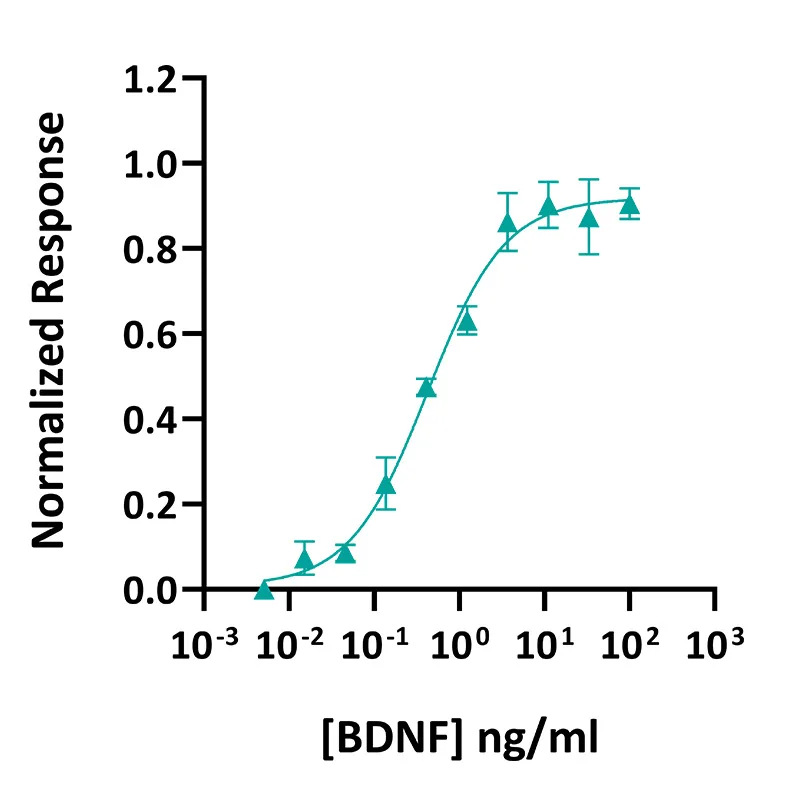
Recombinant BDNF activity was determined using a NFAT-luciferase reporter assay in transfected HEK293T cells also expressing TrkB. EC50 = 0.58 ng/ml (41 pM). Cells are treated in triplicate with a serial dilution of BDNF for 6 hours. Firefly luciferase activity is measured and normalized to the control Renilla luciferase activity. Data from Qk050 lot #104465.
The specific activity of cell therapy grade BDNF is >5 x 10⁵ IU/mg, which is calibrated against the human BDNF WHO standard (NIBSC code: 96/534).
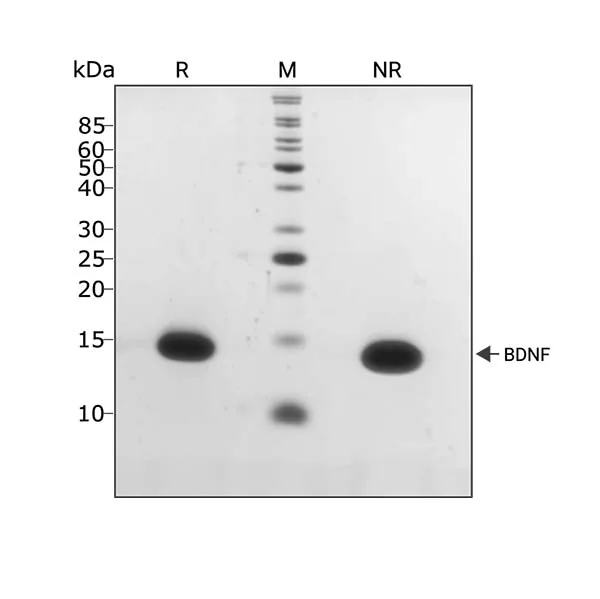
Qk050 migrates as a single band at 14 kDa in non-reducing (NR) conditions and upon reduction (R). No contaminating protein bands are visible. Purified recombinant protein (3 µg) was resolved using 15% w/v SDS-PAGE in reduced (+β-mercaptothanol, R) and non-reduced (NR) conditions and stained with Coomassie Brilliant Blue R250. Data from Qk050 lot #104346.
Mass spectrometry: single species with expected mass
Purity >98%, by SDS-PAGE quantitative densitometry
Recovery from stock vial: >95%
Sterility tested and mycoplasma negative
Endotoxin: <0.05 EU/μg protein
Residual host cell protein <10 ng/µg
Residual host cell DNA <10 ng/μg
N-terminal sequence analysis
We are a company founded and run by scientists to provide a service and support innovation in stem cell biology and regenerative medicine. All our products are exceptionally high purity, with complete characterisation and bioactivity analysis on every lot.
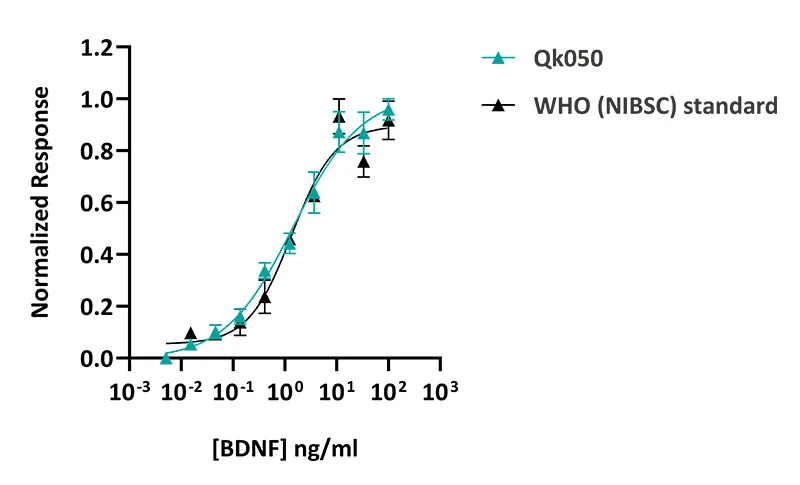
Qkine BDNF was as bioactive as the WHO (NIBSC) standard BDNF. BDNF activity was determined using a NFAT luciferase reporter assay in transiently transfected HEK293 cells also expressing TrkB. Transfected cells were treated in triplicate with a serial dilution of BDNF for 6 hours. Firefly activity was measured and normalized to the control Renilla luciferase activity. Data from Qk050 lot #204714 EC50 = 1.46 ng/ml (104 pM). WHO (NIBSC) EC50 = 1.36 ng/ml.
Brain-derived neurotrophic factor (BDNF) is a member of neurotrophin family which includes nerve growth factor (NGF) and neurotrophin–3/4/5 (NT–3/4/5) [1,2]. BDNF plays a crucial role during embryonic development and the maintenance of the nervous system during adulthood. It mediates many aspects, including the survival, growth, maintenance, and differentiation of neural stem cells and mature neurons [3,4]. It stimulates neurogenesis and promotes the growth of dendrites and axons [5,6]. It is also involved in synaptic plasticity, forming and strengthening synapses in response to experience and learning [7]. Finally, it regulates the neuroprotection as it is involved in neural repair and recovery [8].
In cell culture, recombinant human BDNF supports the survival and growth of neurons and establishes and strengthens synapses. It is used in combination with other growth factors to maintain neurons and to differentiate human-induced pluripotent stem cell-derived neural progenitors into neurons [5]. It is used for the differentiation and maturation of dopaminergic neurons with glial-derived neurotrophic factor (GDNF), FGF-8a/FGF-8b, and Shh [9–11]. Glutamatergic and GABAergic neurons are maintained with combinations of BDNF, GDNF, NT-3, or insulin-like growth factor 1 (IGF-1) [12–14]. Cholinergic neurons are obtained using BDNF, IGF-1, and NGF [15,16]. Also, the culture of cortical organoids require BDNF and GDNF for maturation [17].
BDNF is released by various cells including neurons, glial cells (astrocytes and microglia), immune cells (T cells and macrophages), as well as skeletal muscles. It has several precursor isoforms and its mature active form is a dimer stabilised by a cysteine knot composed of 119 amino acids and a molecular weight of around 13 kDa [18]. The mature isoform binds to the receptor tropomyosin receptor kinase B (TrkB) with high affinity to activate MAPK, PI3K and PLC-γ signalling cascades [19,20]. These pathways are related to the survival of neurons, growth of dendrites and axons, development of synapses, and learning- and memory-dependent synaptic plasticity19. In addition, this protein binds to p75 neurotrophin receptor (p75NTR) with lower affinity to activate the NF-kB activation [21].
Impaired BDNF signaling has been linked to several diseases such as neurodegenerative diseases such as Alzheimer’s and Parkinson’s diseases, neurological disorders such as depression and anxiety disorders, as well as spinal cord injury [22,23]. Recombinant BDNF and other neurotrophins such as NGF and NT-3 are a growing area of research as potential targets [22,24]. For example, pharmacological agents or gene therapy could increase BDNF production and release which may have therapeutic potential for conditions like amyotrophic lateral sclerosis and depression. Also, targeted delivery of this protein could be beneficial to preserve nerve function, promote healthy brain ageing, and regenerate the loss of neurons.
[1] Maisonpierre, P. C. et al. NT-3, BDNF, and NGF in the developing rat nervous system: Parallel as well as reciprocal patterns of expression. Neuron 5, 501–509 (1990). doi: 10.1016/0896-6273(90)90089-x
[2] Skaper, S. D. The Neurotrophin Family of Neurotrophic Factors: An Overview. in Neurotrophic Factors: Methods and Protocols (ed. Skaper, S. D.) 1–12 (Humana Press, 2012). doi:10.1007/978-1-61779-536-7_1.
[3] Ghosh, A., Carnahan, J. & Greenberg, M. E. Requirement for BDNF in Activity-Dependent Survival of Cortical Neurons. Science 263, 1618–1623 (1994). doi: 10.1126/science.7907431
[4] Hyman, C. et al. BDNF is a neurotrophic factor for dopaminergic neurons of the substantia nigra. Nature 350, 230–232 (1991). doi: 10.1038/350230a0
[5] Brafman, D. A. Generation, Expansion, and Differentiation of Human Pluripotent Stem Cell (hPSC) Derived Neural Progenitor Cells (NPCs). in Stem Cell Renewal and Cell-Cell Communication: Methods and Protocols (ed. Turksen, K.) 87–102 (Springer, 2015). doi:10.1007/7651_2014_90
[6] Chen, B.-Y. et al. Brain-derived neurotrophic factor stimulates proliferation and differentiation of neural stem cells, possibly by triggering the Wnt/β-catenin signaling pathway. J. Neurosci. Res. 91, 30–41 (2013). doi: 10.1002/jnr.23138
[7] Bramham, C. R. & Messaoudi, E. BDNF function in adult synaptic plasticity: The synaptic consolidation hypothesis. Prog. Neurobiol. 76, 99–125 (2005). doi: 10.1016/j.pneurobio.2005.06.003
[8] Park, H. & Poo, M. Neurotrophin regulation of neural circuit development and function. Nat. Rev. Neurosci. 14, 7–23 (2013). doi: 10.1038/nrn3379
[9] Perrier, A. L. et al. Derivation of midbrain dopamine neurons from human embryonic stem cells. Proc. Natl. Acad. Sci. U. S. A. 101, 12543–12548 (2004). doi: 10.1073/pnas.0404700101
[10] Brennand, K. et al. Modeling schizophrenia using hiPSC neurons. Nature 473, 221–225 (2011). doi: 10.1038/nature09915
[11] Kriks, S. et al. Dopamine neurons derived from human ES cells efficiently engraft in animal models of Parkinson’s disease. Nature 480, 547–551 (2011). doi: 10.1038/nature10648
[12] Fernandopulle, M. S. et al. Transcription-factor mediated differentiation of human iPSCs into neurons. Curr. Protoc. Cell Biol. 79, e51 (2018). doi: 10.1002/cpcb.51
[13] Li, X.-J. et al. Specification of motoneurons from human embryonic stem cells. Nat. Biotechnol. 23, 215–221 (2005). doi: 10.1038/nbt1063
[14] Lin, L., Yuan, J., Sander, B. & Golas, M. M. In Vitro Differentiation of Human Neural Progenitor Cells Into Striatal GABAergic Neurons. Stem Cells Transl. Med. 4, 775–788 (2015). doi: 10.5966/sctm.2014-0083
[15] Liu, Y. et al. Medial ganglionic eminence–like cells derived from human embryonic stem cells correct learning and memory deficits. Nat. Biotechnol. 31, 440–447 (2013). doi: 10.1038/nbt.2565
[16] Nilbratt, M., Porras, O., Marutle, A., Hovatta, O. & Nordberg, A. Neurotrophic factors promote cholinergic differentiation in human embryonic stem cell-derived neurons. J. Cell. Mol. Med. 14, 1476–1484 (2010). doi: 10.1111/j.1582-4934.2009.00916.x
[17] Jacob, F. et al. Human Pluripotent Stem Cell-Derived Neural Cells and Brain Organoids Reveal SARS-CoV-2 Neurotropism Predominates in Choroid Plexus Epithelium. Cell Stem Cell 27, 937-950.e9 (2020). doi: 10.1016/j.stem.2020.09.016
[18] Barde, Y. a., Edgar, D. & Thoenen, H. Purification of a new neurotrophic factor from mammalian brain. EMBO J. 1, 549–553 (1982). doi: 10.1002/j.1460-2075.1982.tb01207.x
[19] Colucci-D’Amato, L., Speranza, L. & Volpicelli, F. Neurotrophic Factor BDNF, Physiological Functions and Therapeutic Potential in Depression, Neurodegeneration and Brain Cancer. Int. J. Mol. Sci. 21, 7777 (2020). doi: 10.3390/ijms21207777
[20] Foltran, R. B. & Diaz, S. L. BDNF isoforms: a round trip ticket between neurogenesis and serotonin? J. Neurochem. 138, 204–221 (2016). doi: 10.1111/jnc.13658
[21] Reichardt, L. F. Neurotrophin-regulated signalling pathways. Philos. Trans. R. Soc. B Biol. Sci. 361, 1545–1564 (2006). doi: 10.1098/rstb.2006.1894
[22] Mattson, M. P., Maudsley, S. & Martin, B. BDNF and 5-HT: a dynamic duo in age-related neuronal plasticity and neurodegenerative disorders. Trends Neurosci. 27, 589–594 (2004). doi: 10.1016/j.tins.2004.08.001
[23] Mattson, M. P. & Scheff, S. W. Endogenous Neuroprotection Factors and Traumatic Brain Injury: Mechanisms of Action and Implications for Therapy. J. Neurotrauma 11, 3–33 (1994). doi: 10.1089/neu.1994.11.3
[24] Keefe, K. M., Sheikh, I. S. & Smith, G. M. Targeting Neurotrophins to Specific Populations of Neurons: NGF, BDNF, and NT-3 and Their Relevance for Treatment of Spinal Cord Injury. Int. J. Mol. Sci. 18, 548 (2017). doi: 10.3390/ijms18030548
Thomas J (Thesis)
DOI: ThesisFeatherby SJ, Faulkner EC, Gordon A and Ettelaie C.
DOI: doi.org/10.1007/s10571-025-01658-7Grass T, Cosacak IM, Ordureau A et al.
DOI: doi.org/10.64898/2026.02.19.706886Sozza F, Romano A, D’Elia N et al.
DOI: doi.org/10.64898/2026.05.31.729073Vasoya D, Keavey LK, Levit C et al.
DOI: doi.org/10.64898/2026.06.30.735652Urbanek A, Dear AJ, Rhodes DP et al.
DOI: doi.org/10.1038/s41467-026-79028-0Recombinant Brain-Derived Neurotrophic Factor is a synthetic form of BDNF. Qkine recombinant human BDNF is expressed in E. coli.
BDNF plays a crucial role during embryonic development and the maintenance of the nervous system during adulthood including the survival, growth, maintenance, and differentiation of neurons, growth of dendrites and axons, and synaptic plasticity.
The BDNF protein is encoded by the BDNF gene on chromosome 11.
NGF, GDNF, and BDNF are all part of the neurotrophins or neurotrophic factors family. They all regulate the development, growth, and survival of neurons and have more specific roles. NGF is associated with the growth and maintenance of sensory and sympathetic neurons. BDNF and GDNF are both associated with dopaminergic, glutamatergic, and GABAergic neurons. In addition, BDNF plays a crucial role in synapses formation whereas GDNF is involved in the growth and maintenance of other glial cells such as astrocytes.
Neurotrophic factors (also known as neurotrophins) include Nerve Growth Factor (NGF), Brain-Derived Neurotrophic Factor (BDNF), Glial-Derived Neurotrophic Factor (GDNF), Neurotrophin-3 (NT-3), and Neurotrophin-4/5 (NT-4/5).
Neurotrophin proteins regulate neuronal growth and survival, neuroprotection, neurotransmitter release, synaptic function, and plasticity within the adult central and peripheral nervous system.
Our products are for research use only and not for diagnostic or therapeutic use. Products are not for resale.
For use in manufacturing of cellular or gene therapy products. Not intended for in vivo applications.

£100, $140 or €120 Qkine gift card for product reviews with an image and £50, $70 or €60 for reviews without an image.
Recombinant human BDNF protein (Qk050-CTG)