
 Recombinant bovine BMP-4 protein (Qk135)
 Price range: £250.00 through £3,190.00View product
Price range: £250.00 through £3,190.00
BMP-4 (bone morphogenetic protein 4) is a key regulator of embryogenesis and supports the differentiation of embryonic stem cells and induced pluripotent stem cells. In addition, BMP-4 protein plays roles in the differentiation of mesenchymal cells to adipocytes, epithelial cancer EMT, and regulating neuronal and glial cell development.
Qkine BMP-4 is a highly pure, animal origin-free and carrier protein-free 24 kDa disulfide–linked bioactive dimer comprised of the mature domain of bovine BMP-4 protein.
In stock
Orders are typically shipped same or next day (except Friday).
Easy world-wide ordering, direct or through our distributors.
Price range: £250.00 through £3,190.00
Buy online with secure credit card or purchase order. For any questions, please email [email protected]
>98%, by SDS-PAGE quantitative densitometry
Expressed in E. coli
Animal origin-free (AOF) and carrier protein-free
Lyophilized from acetonitrile, TFA
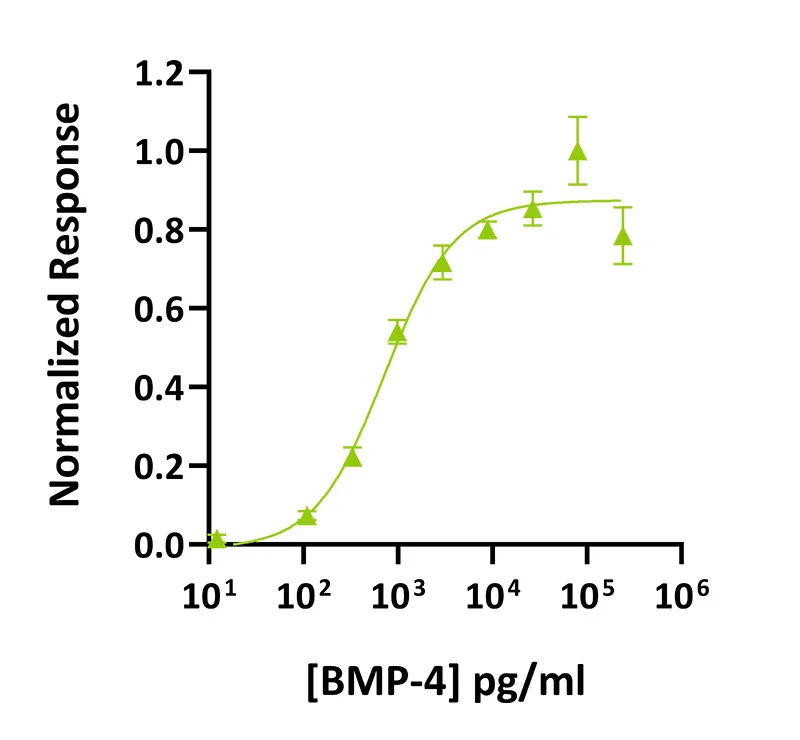
BMP-4 activity was determined using the BMP4-responsive firefly luciferase reporter assay in transfected HEK293T cells. Cells were treated in triplicate with a serial dilution of BMP-4 for 6 hours. Firefly luciferase activity was measured and normalized to the control Renilla luciferase activity. EC50 = 30.2 pM (0.72 ng/ml).
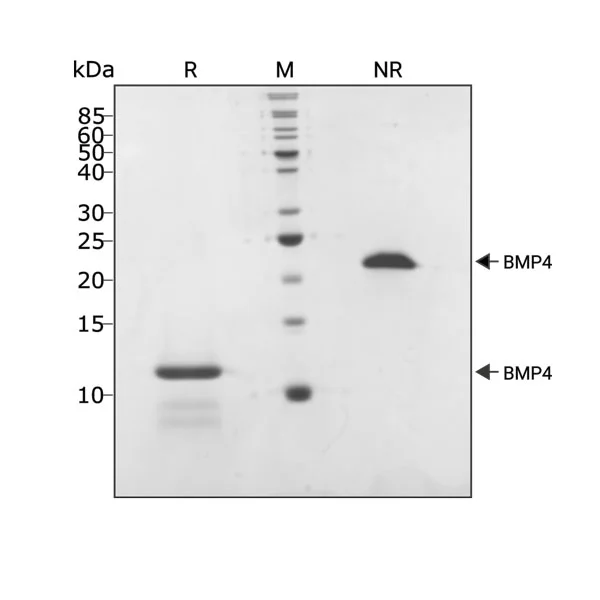
BMP-4 dimer migrates as a single band at 24 kDa in non-reducing (NR) and 13 kDa as a single monomeric species upon reduction (R). High purity yield of dimeric protein (bioactive form). Purified recombinant protein (3 μg) was resolved using 15% w/v SDS-PAGE in reduced (+β-mercaptoethanol, R) and non-reduced conditions (NR) and stained with Coomassie Brilliant Blue R250.
Mass spectrometry: single species with expected mass
Recovery from stock vial: >95%
Endotoxin: <0.05 EU/μg protein
We are a company founded and run by scientists to provide a service and support innovation in stem cell biology and regenerative medicine. All our products are exceptionally high purity, with complete characterisation and bioactivity analysis on every lot.
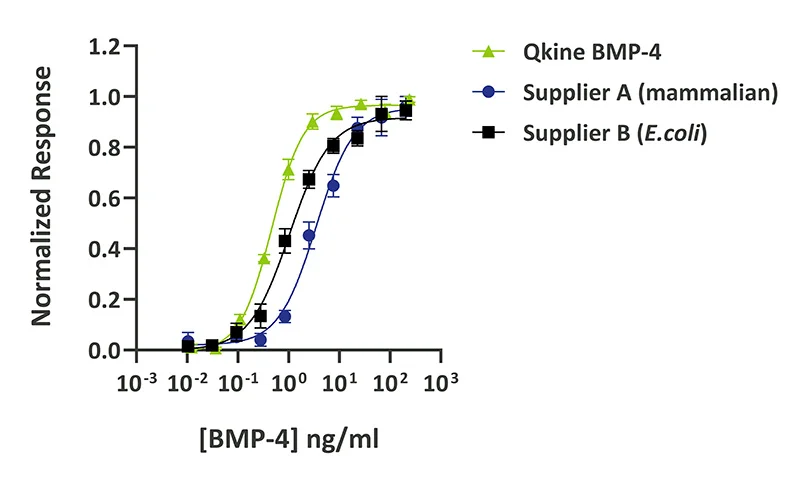
Qkine BMP-4 has higher bioactivity than bacterial and mammalian-expressed BMP-4 from alternative suppliers. Quantitative luciferase assay with Qkine BMP-4 (green) and BMP-4 from alternative suppliers (Supplier A, blue; Supplier B, black). Cells were treated in triplicate with a serial dilution of BMP-4 for 6 hours. Firefly luciferase activity was measured and normalized to control Renilla luciferase activity.
Bone morphogenetic protein 4 (BMP-4) is part of the TGF-β superfamily of growth factors. BMP-4 is a key regulator of embryogenesis with roles in gastrulation, establishment of a dorsal-ventral axis, and regulation of limb development [1]. As their name suggest the BMP family is involved in the development and maintenance of bone and cartilage; in adults BMP-4 has roles bone and cartilage metabolism, as well as neurogenesis [2] and hematopoietic stem cell homing [3].
BMP-4 protein acts through two serine-threonine kinase receptors; Bone morphogenetic protein receptor (BMPR) 1 and BMPR2, via these receptors BMP-4 invokes Smad and map kinase pathways and consequently alters target gene transcription [1].
Recombinant BMP-4 is an essential growth factor for differentiation of induced pluripotent (iPSC) and embryonic stem cells to mesoderm lineage for further differentiation to cardiac [4, 5] and stromal cells [5]. BMP-4 is also used in a wide range of stem cell and organoid differentiation protocols. It is used in choroidal and melanocyte differentiation [6] and intestinal organoids [7]. BMP-4 has a morphogenetic effects in spinal organoids and modulates the arrangement and concentration of dorsal neural tube cell types in these organoids [8].
BMP-4 is a TGF-beta family protein essential for development, particularly eye, heart and cranial formation. It is also essential in many stem cell and organoid differentiation media related to mesodermal lineage.
BMP-4 is expressed by a wide range of cells and tissues through the body and expression and effect on different tissues varies dependent on the developmental stage. BMP-4 is particularly expressed by endothelial cells, mesenchymal cells, epithelial cells and adipocytes.
Yes, BMP-4 is a TGF-beta family cytokine.
The activated type I receptor phosphorylates and activates receptor-regulated Smads (R-SMADs), which are SMAD1, SMAD5, and SMAD8 proteins. BMP-4 can also activate the p38 mitogen-activated protein kinase (MAPK) pathway, in addition to the Smad pathway.
BMP-4 activates the Smad and MAPK pathways to effect transcription of target genes.
BMPs induce specific cellular responses through their interaction with type I and type II cell surface receptors, which activates the serine/threonine kinase activity of the receptors 5. Three distinct BMP type II receptors (BMPRIIs) and four BMP type I receptors (BMPRIs), also termed activin receptor‐like kinases (ALKs), have been characterized. BMP-2 and BMP-4 bind most strongly to ALK3 and ALK6.
BMP pathways are actively regulated by BMP antagonists including chordin, noggin and gremlin, these bind to BMP-4 and prevent it from binding to its receptors.
BMP-4 is widely used in stem cell and organoid differentiation protocols as well as the study of body patterning and development.
Our products are for research use only and not for diagnostic or therapeutic use. Products are not for resale.
For use in manufacturing of cellular or gene therapy products. Not intended for in vivo applications.

£100, $140 or €120 Qkine gift card for product reviews with an image and £50, $70 or €60 for reviews without an image.
Recombinant bovine BMP-4 protein (Qk135)