
 FGF-2 species-matched kit (Qk501)
 Original price was: £945.00.£405.00Current price is: £405.00.
Original price was: £945.00.£405.00Current price is: £405.00.
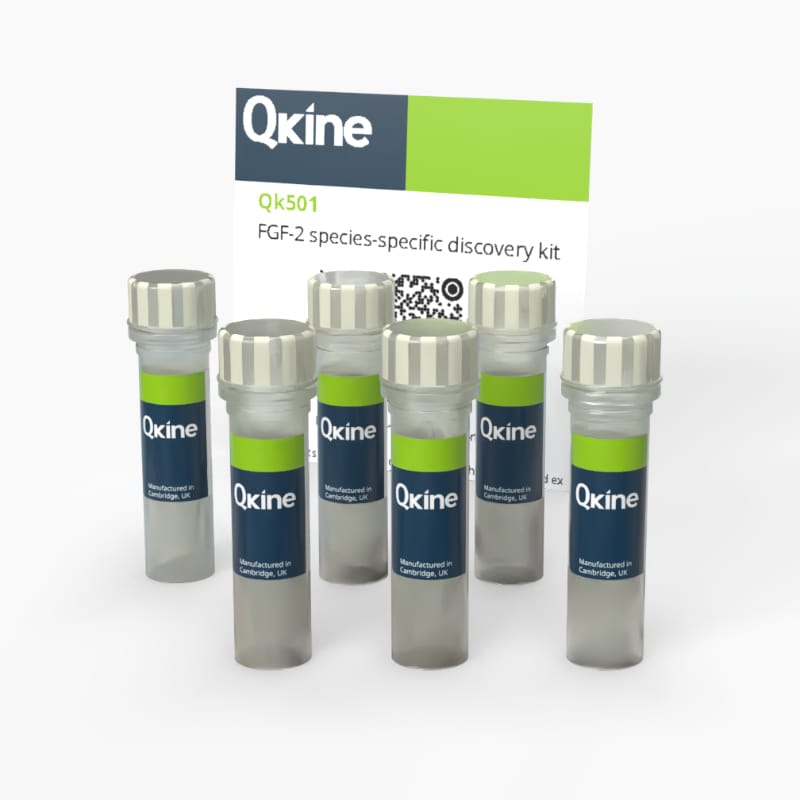
For rapid testing of multiple species FGF-2 and thermostable FGF-2 to replace human proteins in cell cultivated meat. FGF-2 is commonly used in cultivated meat cell culture for the differentiation and maintenance of cells, but human FGF-2 is often used for this process.
It is generally accepted that best practice is to use growth factors from the target species for reasons of consumer acceptance, regulatory considerations and species-matched activity. Receptor binding affinity and efficacy may differ depending on each species, resulting in higher concentration necessary for desired results in culture if non-species specific FGF-2 is used.
The FGF-2 species-matched Discovery Kit (Qk501) contains 6 different forms of FGF-2, allowing easy optimization studies for researchers looking to replace human growth factors with species-matched FGF-2, as well as thermostable versions of FGF-2 proteins.
In stock
Orders are typically shipped same or next day (except Friday).
Easy world-wide ordering, direct or through our distributors.
Original price was: £945.00.£405.00Current price is: £405.00.
Buy online with secure credit card or purchase order. For any questions, please email [email protected]
>98%, by SDS-PAGE quantitative densitometry
Bioactivity Guaranteed
Expressed in E. coli
Animal origin-free (AOF) and carrier protein-free
Manufactured in our Cambridge, UK laboratories
Lyophilized
Cellular agriculture and cultivated meat cell culture media optimization
Serum-free media development

Zebrafish FGF-2 – Qk002 – 100 µg
Used extensively to support the maintenance and proliferation of human and mouse induced pluripotent (iPSC) and embryonic stem cells (ESC)
Bovine/porcine FGF-2 (154 aa) – Qk056 – 50 µg
The long form of FGF-2 used for the development of optimized serum-free culture media for species-matched bovine (cow) and porcine (pig) cultivated meat and veterinary research applications.
Bovine/porcine FGF-2 (145 aa) – Qk040 – 50 µg
For the development of species-matched bovine (cow) and porcine (pig) cellular agriculture protocols and veterinary research applications.
Bovine/porcine FGF2-G3 (145 aa) – Qk080 – 50 µg
thermostable engineered form of bovine FGF-2. This is the 145 aa mature domain of FGF-2 (Qk040). The functional half-life has increased from <10 h (wild-type) to >7 days (FGF2-G3)
Bovine/porcine FGF2-G3 (154 aa) – Qk081 – 50 µg
A thermostable engineered form of bovine FGF-2. This is the 154 aa mature domain of FGF-2 (Qk056). The functional half-life has increased from <10 h (wild-type) to >7 days (FGF2-G3)
Human FGF2-G3 (154 aa) – Qk053 – 50 µg
A thermostable engineered form of human FGF-2. Qk053 is the 154 aa mature domain of FGF-2 (Qk027). The functional half-life has increased from <10 h (wild-type) to >7 days (FGF2-G3).
Mass spectrometry: single species with expected mass
Recovery from stock vial: >95%
Endotoxin: <0.05 EU/μg protein
We are a company founded and run by scientists to provide a service and support innovation in stem cell biology and regenerative medicine. All our products are exceptionally high purity, with complete characterisation and bioactivity analysis on every lot.
Fibroblast growth factor 2 (FGF-2) – also known as basic fibroblast growth factor (bFGF) – has a broad range of physiological roles, including regulation of cell proliferation and differentiation. FGF-2 is used to support the maintenance of embryonic stem cells and proliferation and differentiation of induced pluripotent and mesenchymal stem cells [1-3].
FGF-2 is inherently unstable and prone to proteolytic degradation and aggregation. This fundamental biochemical instability, and therefore low half-life in culture media (<10 h), is an important contribution to the need for frequent media changes and challenges in improving homogeneity during stem cell proliferation and subsequent differentiation. To improve the stability of FGF-2 for stem cell and cultivated meat applications, an optimal set of nine amino acid substitutions that stabilize FGF-2 were identified. The biological activity of wild-type FGF-2 is <50% after 10h incubation with conditioned media. In contrast, no reduction in FGF2-G3 biological activity is observed after >7 days incubation with conditioned media at 37 oC.
It is generally accepted that best practice is to use growth factors from the target species for reasons of consumer acceptance, regulatory considerations and species-matched activity including differences in receptor binding and efficacy in some cases. Some growth factor protein sequences are highly conserved and 100% identical across species. There is currently a lack of commercial availability of cultured-meat and fish relevant species-matched growth factors, so often human proteins, or indeed bovine serum, are used as a surrogate. It’s advisable to determine the conservation of protein sequence when selecting appropriate growth factors and switch to species-matched proteins if feasible.
Fibroblast growth factor 2 (FGF-2), also known as basic fibroblast growth factor (bFGF) is a growth factor and signaling protein.
FGF-2 is expressed in a developmental and tissue specific manner. It’s expression is tightly controlled in normal tissues and it can be detected in all major tissues.
FGF-2 is essential for normal embryonic development. It has roles in cell survival and proliferation, angiogenesis, tumorigenesis, wound healing and tissue repair.
FGF-2 binds to and signals though all four of the FGF receptors FGFR1-4.
FGFRs phosphorylate specific tyrosine residues and activate the RAS-MAPK, PI3K-AKT, PLCγ, and STAT intracellular signaling pathways.
FGF-2 is used to maintain the pluripotency of stem cells in culture.
Recombinant FGF2-G3 (FGF2-STAB®) is a thermostable, engineered form of FGF-2 (bFGF). This modification significantly increases the protein’s functional half-life — from <10 hours for wild-type FGF-2 to >7 days for FGF2-G3 — improving stability and consistency in culture systems.
Our products are for research use only and not for diagnostic or therapeutic use. Products are not for resale.
For use in manufacturing of cellular or gene therapy products. Not intended for in vivo applications.

£100, $140 or €120 Qkine gift card for product reviews with an image and £50, $70 or €60 for reviews without an image.
FGF-2 species-matched kit (Qk501)