
Animal-free, defined media outperforms FBS for canine AD-MSC expansion: A case for lot-to-lot consistency
A collaborative study between Media City Scientific, Qkine, and Elita Pet
Introduction
Adipose-derived mesenchymal stem cells (AD-MSCs) occupy a central position in veterinary regenerative medicine. For commercial cell banking operations, expansion efficiency and phenotypic consistency across passages directly determine the number of therapeutic doses derivable from a single donor harvest [1]. Elita Pet operates Australia’s first commercial stem cell bank for companion animals, providing validated AD-MSC banks for veterinary therapy applications.
FBS has historically been the default expansion supplement for MSC culture, but its intrinsic lot-to-lot variability poses a risk for banking operations that depend on reproducible, high-yield expansion [2]. One batch may support robust cell expansion, while the next batch may fail entirely. This is not a theoretical risk: in this study, the same canine AD-MSC banks that expanded successfully in defined conditions underwent complete culture failure within two passages when exposed to a particular batch of 20% FBS. This is the concentration routinely used by Elita Pet in standard protocols.
Qkine are a specialist recombinant protein manufacturer producing completely animal origin-free, highly bioactive growth factors and cytokines, with guaranteed lot-to-lot consistency. FRS™ Pioneer (Media City Scientific) is a fully chemically defined, animal-origin-free serum replacement formulated for broad cell type compatibility and lot-to-lot consistency. While FRS Pioneer is standardly used for 100% replacement of FBS in the culture of immortalized cell lines, here we report the performance of a fully defined, animal-origin-free culture system for AD-MSCs, comprising FRS™ Pioneer supplemented with Qkine growth factors. We report expansion over 21 days and five passages, with greater yields achieved compared to FBS-supplemented controls.
Methods
Cell source
Canine adipose-derived mesenchymal stem cells were sourced from Elita Pet’s cryobank. Cells were thawed into FBS-containing medium and, after 24 hours, directly adapted into experimental conditions.
Culture conditions
Cells were cultured in DMEM/F12 basal medium supplemented with one of five conditions: (1) no supplement; (2) 10% FRS™ Pioneer; (3) 9% FRS™ Pioneer + 1% FBS; (4) 10% FBS; or (5) 10% FRS™ Pioneer + 10 ng/ml FGF2 (Qk025) + 10 ng/ml PDGF-BB (Qk044). Cells were maintained across five passages over 21 days and cumulative population doublings recorded.
Adhesion strategy
For serum-free conditions, 50% conditioned medium from the preceding passage was retained and combined with 50% fresh medium at each re-seed, exploiting the cells’ endogenous ECM production to maintain surface conditioning without exogenous coating. This protocol is compatible with standard cell culture plasticware.
Alternatively, results were equivalent when standard TC-treated plates were coated with GECKO™ adhesion proteins (Media City Scientific) at 1.25 µg/cm2 for 2h at 37 °C prior to receiving cells.
Primary cells are inherently variable between donors and isolates; the conditions described here represent a validated starting point, and minor optimization of growth factor concentrations or adhesion coating conditions may be beneficial for specific cell sources.
Results
Defined system achieves 30% greater expansion than FBS
Canine AD-MSCs in fully defined medium (FRS™ Pioneer + FGF-2 + PDGF-BB) achieved approximately 20 cumulative population doublings over 21 days, compared to approximately 15 doublings in the 10% FBS positive control. This is a 30% increase in total expansion yield. For a commercial banking operation, where output per run determines both cost of goods and clinical dose count, this is a material advantage.
The 9% FRS™ Pioneer / 1% FBS hybrid condition performed comparably to the 10% FBS positive control, providing a practical, low-friction entry point for laboratories not yet ready for a fully defined protocol.
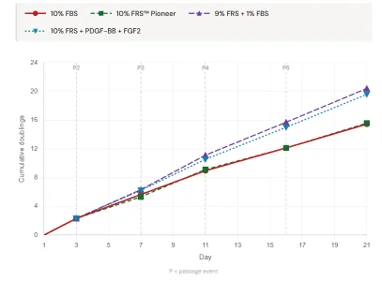
Figure 1. Cumulative population doublings of canine AD-MSCs at day 21. Defined medium (FRS™ Pioneer + 10 ng/ml FGF-2 + 10 ng/ml PDGF-BB) achieved approximately 20 doublings over 21 days, a 30% increase over the 10% FBS-supplemented control. Dashed vertical lines indicate passage events. Points indicate measured values; lines represent interpolated growth between passage events. GFs: 10 ng/ml PDGF-BB + 10 ng/ml FGF-2. Basal media alone failed to support proliferation beyond 72h.
FBS batch variability
An interesting ancillary finding was the complete culture failure observed during attempts to expand the AD-MSC banks in media conditions containing 20% of a given batch of FBS. This is a common, industry-standard concentration of FBS, and the conditions in which Elita Pet’s banks were initially generated. The lack of tolerance for this batch of serum illustrates the systemic risk inherent to FBS-dependent protocols in banking operations. Batch qualification mitigates but does not eliminate this risk; in addition to the cost and time involved in qualifying a new lot, risk of stock shortages at a critical manufacturing point remains [3]. A chemically defined serum replacement eliminates this liability entirely.
Morphology and phenotype
AD-MSCs maintained a characteristic spindle-shaped, fibroblast-like morphology under all proliferative conditions. No substantial morphological differences were observed between cells expanded in FRS™ Pioneer + growth factors and those maintained in FBS, consistent with phenotypic stability across the defined system.
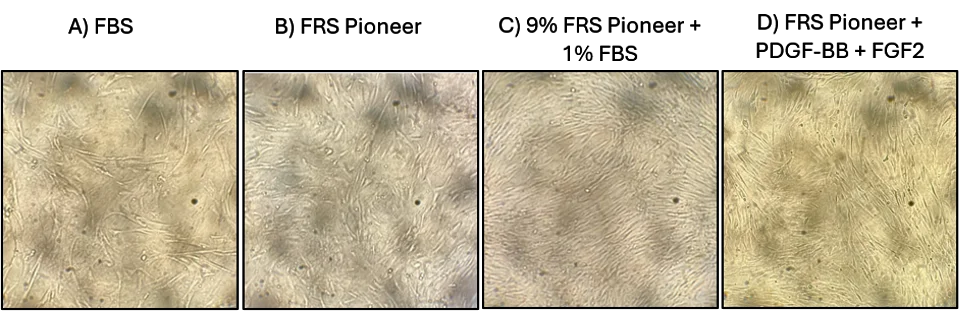
Figure 2. Representative light microscopy images of canine AD-MSCs at passage 5 (day 21). Cells in the defined system maintained characteristic spindle morphology comparable to the FBS control.
Conclusion
A fully defined culture system comprising 10% FRS™ Pioneer + FGF-2 + PDGF-BB outperformed 10% FBS for canine AD-MSC expansion over 21 days, achieving approximately 30% greater cumulative population doublings while maintaining healthy morphology and viability across five passages. The inherent lot-to-lot consistency of a chemically defined system eliminates the batch qualification burden associated with FBS procurement and removes a key source of manufacturing variability for banking operations.
For laboratories not yet ready to fully eliminate serum, the 9% FRS™ Pioneer / 1% FBS hybrid provides a practical transition strategy that delivers FBS-comparable performance while substantially buffering against batch-dependent variability. These results support the combination of FRS™ Pioneer with Qkine growth factors as a high-performing, animal-origin-free, defined alternative for canine AD-MSC culture with direct implications for veterinary cell therapy manufacturing.
Further information
Media City Scientific
Media City Scientific manufactures FRS™ Pioneer, a fully chemically defined, animal-origin-free serum replacement engineered for broad primary cell type compatibility and lot-to-lot consistency. FRS™ Pioneer is available directly and through Qkine.
Elita Pet
Elita Pet operates Australia’s first commercial stem cell bank for companion animals, providing validated adipose-derived mesenchymal stem cell banks with direct applications in veterinary regenerative medicine.
Qkine
Qkine are committed to raising the standards of growth factors, cytokines and related proteins to better support long-term and complex stem cell culture.
Enquiries: [email protected] | [email protected]
References
[1] Prządka P, Buczak K, Frejlich E, Gąsior L, Suliga K, Kiełbowicz Z. The Role of Mesenchymal Stem Cells (MSCs) in Veterinary Medicine and Their Use in Musculoskeletal Disorders. Biomolecules. 2021 2;11(8):1141. doi: 10.3390/biom11081141.
[2] Pilgrim CR, McCahill KA, Rops JG, et al. A Review of Fetal Bovine Serum in the Culture of Mesenchymal Stromal Cells and Potential Alternatives for Veterinary Medicine. Front Vet Sci. 2022 3;9:859025. doi: 10.3389/fvets.2022.859025.
[3] Stival ACS, Garcia da Silva AC, Valadares MC, Qualitative and quantitative evaluation of Fetal Bovine Serum composition: toward ethical and best quality in vitro science. NAM Journal. 2025 1:100047. doi: 10.1016/j.namjnl.2025.100047.



All our recombinant proteins are animal-free and come with Bioactivity. Guaranteed.
Featured resources
GECKO™ - adherence solution user guide
Contact us
Our science team is here to help, please contact us if you have any questions.