
 Recombinant mouse/rat BMP-2 protein (Qk009)
 Price range: £250.00 through £3,190.00View product
Price range: £250.00 through £3,190.00
Bone morphogenetic protein 2 (BMP-2) is member of the TGF-β family and a key regulator of embryogenesis and potent differentiation factor of embryonic stem cells (ESC) and induced pluripotent stem cells (iPSC) towards endoderm fates. BMP-2 plays roles in the differentiation of mesenchymal cells to adipocytes, epithelial cancer EMT, chondrogenesis and regulation of neuronal and glial cell development.
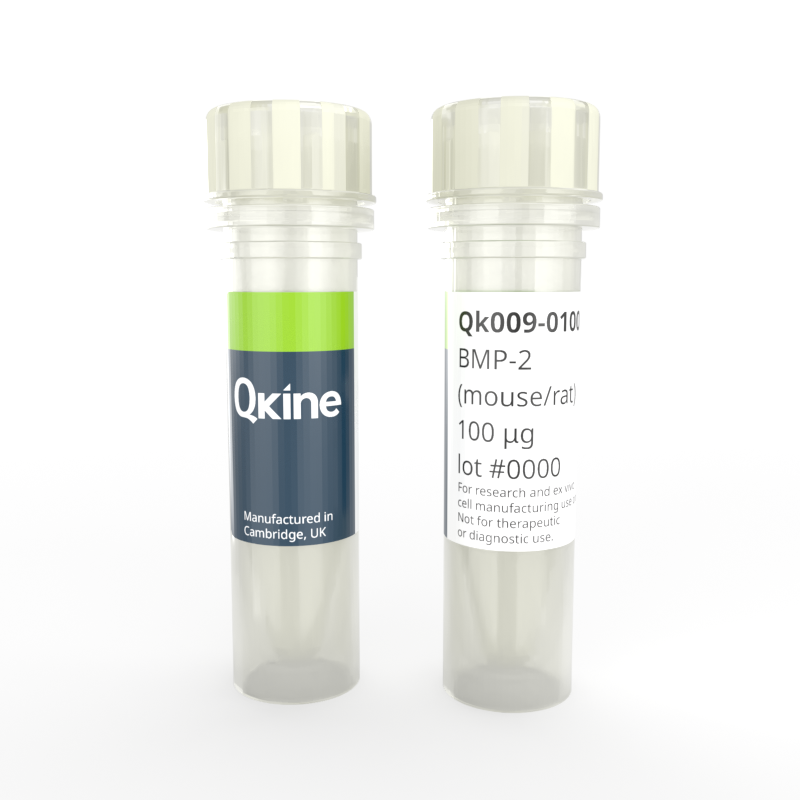
Qkine recombinant mouse/rat BMP-2 is a 26 kDa disulfide–linked bioactive highly pure dimer comprised of the mature domain of the BMP-2 protein, animal origin-free (AOF) and carrier protein-free.
In stock
Orders are typically shipped same or next day (except Friday).
Easy world-wide ordering, direct or through our distributors.
Price range: £250.00 through £3,190.00
Buy online with secure credit card or purchase order. For any questions, please email [email protected]
>98%, by SDS-PAGE quantitative densitometry
Expressed in E. coli
Animal origin-free (AOF) and carrier protein-free
Manufactured in our Cambridge, UK laboratories
Lyophilized from acetonitrile, TFA
Generation of iPSC-derived osteoblasts and chondrocytes
Growth and proliferation of chondrocytes, fibroblasts and primary cells
Neural stem cell proliferation and neuronal differentiation
Stem cell differentiation into neural and microglial lineages

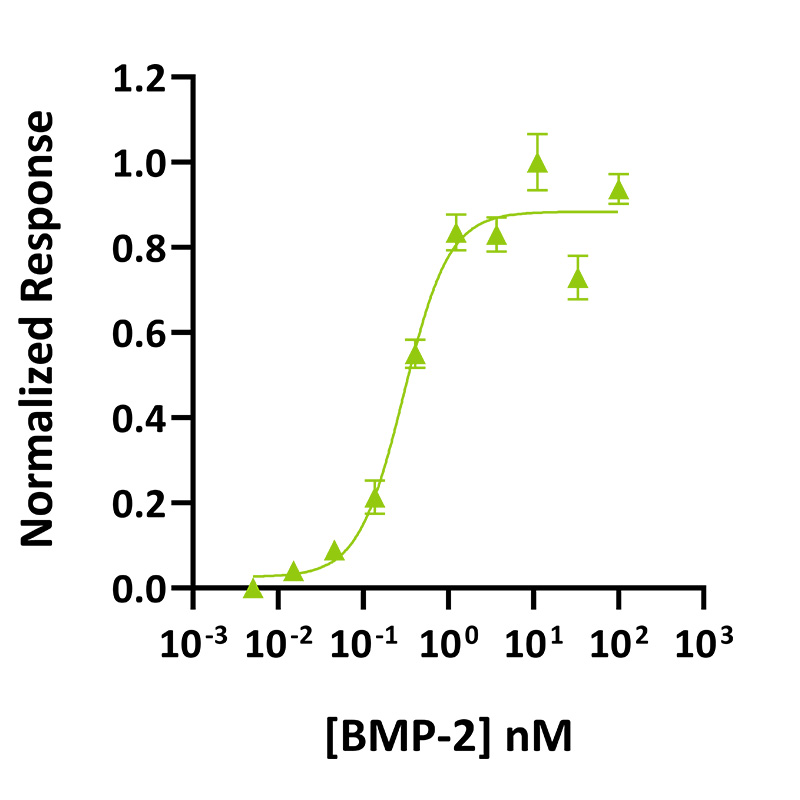
BMP-2 activity was determined using the BMP-2 responsive firefly luciferase reporter assay in stably transfected HEK293T cells. Cells were treated in triplicate with a serial dilution of BMP-2 for 6 hours. Firefly luciferase activity was measured and normalized to the control Renilla luciferase activity. EC50 = 7.8 ng/ml (0.3 nM). Data from lot #010.
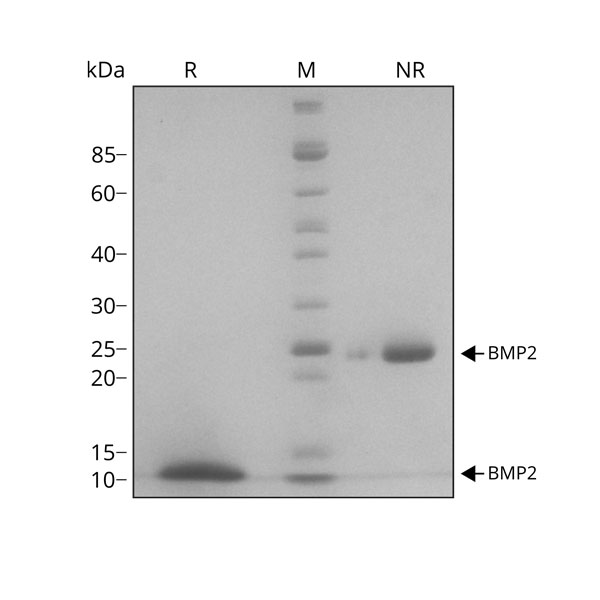
BMP-2 migrates as a single band at 26 kDa in non-reducing (NR) conditions and 13 kDa as a single monomeric species upon reduction (R). No contaminating protein bands are visible. Purified recombinant protein (7 µg) was resolved using 15% w/v SDS-PAGE in reduced (+β-mercaptothanol, R) and non-reduced conditions (NR) and stained with Coomassie Brilliant Blue R250.
Mass spectrometry: single species with expected mass
Recovery from stock vial: >95%
Endotoxin: <0.05 EU/μg protein
We are a company founded and run by scientists to provide a service and support innovation in stem cell biology and regenerative medicine. All our products are exceptionally high purity, with complete characterisation and bioactivity analysis on every lot.
Bone morphogenetic protein 2 (BMP-2) is a member of the BMP subgroup of the transforming growth factor beta (TGF-β) superfamily. It plays numerous roles in the developing embryo, such as embryonic patterning along the dorso-ventral axis, organogenesis, limb bud formation, and bone and cartilage growth. BMP-2 protein is a potent differentiation factor and directs pluripotent stem cells towards extra-embryonic endoderm, mesenchymal and neural lineages, and chondrocytes [1]. Recombinant BMP-2 protein induces bone and cartilage formation in vitro and chondrogenesis in adult mesenchymal stem cells [2].
BMP-2 is synthesized as a preproprotein consisting of N-terminal signal peptide, 259 amino acid residue pro-domain and 114 residue mature domain. Proteolytic removal of the propeptide enables mature BMP-2 protein to form active disulfide-linked homodimers, and heterodimers with BMP-7.
Mature BMP-2 protein shares 100% amino acid sequence identity between human, mouse and rat. It also shares 85% amino acid sequence identity with the related protein, BMP-4, but less than 51% identity with other BMPs.
[1] Pera, M. F. et al. Regulation of human embryonic stem cell differentiation by BMP-2 and its antagonist noggin. J. Cell Sci. 117, 1269–80 (2004). doi.org/10.1242/jcs.00970
[2] Schmitt, B. et al. BMP2 initiates chondrogenic lineage development of adult human mesenchymal stem cells in high-density culture. Differentiation. 71, 567–77 (2003). doi.org/10.1111/j.1432-0436.2003.07109003.x
TGF beta family proteins and other growth factors can be very poorly soluble in physiological solutions. Please follow the handling guidance for lyophilized cytokines below to minimize loss of protein due to precipitation or adsorption to plastic. We advise storing the recombinant protein at very low pH before dilution in cell culture media or final working solutions. Low pH will also assist in maintaining the correct disulfide structure of the protein by minimizing disulfide bond exchange reactions.
Every effort is made to ensure samples are sterile; however, we recommend sterile filtering after dilution in media or the final working solution.
Bone morphogenetic protein 2 (BMP-2) is a key regulator of embryogenesis and supports the differentiation of induced pluripotent stem cells (iPSC) and embryonic stem cells (ESC).
BMP-2 is expressed in a wide range of tissues, including bone, cartilage, liver, lungs, and vascular cells.
Yes, BMP-2 is a member of the TGF-β family of cytokines.
BMP2 gene encodes for bone morphogenetic protein 2, a secreted TGF-β family protein.
BMP-2 primarily binds to BMP2R transmembrane serine/threonine kinase.
BMPR2 and a type I receptor initiate signaling pathways involved in bone and cartilage growth and differentiation
BMP-2 binding activates the canonical (Smad) pathway, where the receptors phosphorylate and activate Smad proteins, which then enter the nucleus to regulate gene transcription. BMP-2 also activates non-Smad pathways such as the MAPK, PKC, and PI3K/Akt pathways.
BMP-2 can be used is primarily used in neural and osteogenic differentiation protocols. It can induce the differentiation of mesenchymal stem cells (MSCs) into osteoblasts and chondrocytes and pluripotent stem cells into neurons.
Our products are for research use only and not for diagnostic or therapeutic use. Products are not for resale.
For use in manufacturing of cellular or gene therapy products. Not intended for in vivo applications.

£100, $140 or €120 Qkine gift card for product reviews with an image and £50, $70 or €60 for reviews without an image.
Recombinant mouse/rat BMP-2 protein (Qk009)