
 Recombinant human FGF-4 protein (Qk004)
 Price range: £155.00 through £1,540.00View product
Price range: £155.00 through £1,540.00


Human fibroblast growth factor 4 (FGF-4) protein is used for the proliferation and differentiation of embryonic and induced-pluripotent and tissue (mesenchymal) stem cells and promotes neural stem cell proliferation. Recombinant FGF-4 is an important component of cardiac, intestinal and other organoid culture media.
High purity and bioactivity 14 kDa, bioactive domain of human FGF-4, animal origin-free (AOF) and carrier-protein free.
This protein is also available as GMP compliant Cell Therapy Grade, to enquire email [email protected].
In stock
Orders are typically shipped same or next day (except Friday).
Easy world-wide ordering, direct or through our distributors.
Price range: £155.00 through £1,540.00
Buy online with secure credit card or purchase order. For any questions, please email [email protected]
>98%, by SDS-PAGE quantitative densitometry
Animal origin-free (AOF) and carrier protein-free
Expressed in E. coli
Manufactured in our Cambridge, UK laboratories
Lyophilized from HEPES, NaCl, mannitol
Hindgut organoids from iPSC-derived human posterior gut endoderm cells
Neural stem cell proliferation and neuronal differentiation
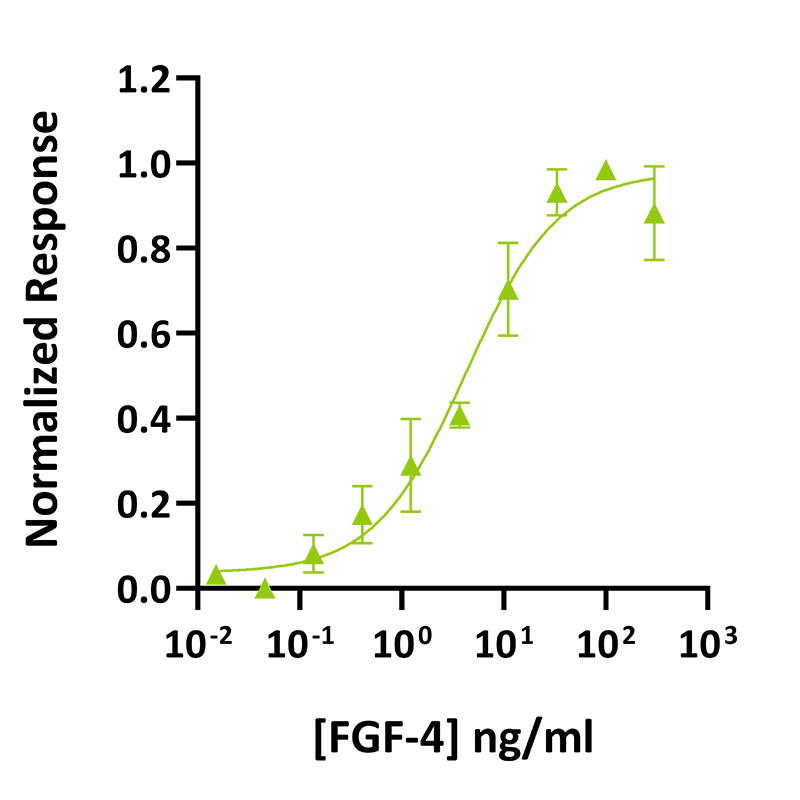
FGF-4 activity was determined using the firefly luciferase reporter assay in stably transfected HEK293T cells. Cells are treated in triplicate with a serial dilution of FGF-4. Firefly luciferase activity is measured and normalized. EC50 = 4.3 ng/ml (306.5 pM). Data from Qk004 lot #104330.
Recombinant human FGF-4 protein migrates as a single band at 14 kDa in non-reducing conditions (NR) and upon reduction (R). No contaminating protein bands are visible. Purified recombinant protein (7 µg) was resolved using 15% w/v SDS-PAGE in reduced (+β-mercaptothanol, R) and non-reduced conditions (NR) and stained with Coomassie Brilliant Blue R250. Data from Qk004 lot #010.

Mass spectrometry: single species with expected mass
Recovery from stock vial: >95%
Endotoxin: <0.05 EU/μg protein
We are a company founded and run by scientists to provide a service and support innovation in stem cell biology and regenerative medicine. All our products are exceptionally high purity, with complete characterisation and bioactivity analysis on every lot.
Qkine FGF-4 bioactivity is comparable to an alternative supplier protein. Quantitative luciferase assay with Qkine FGF-4 (Qk004, green) and alternative supplier FGF-4 (Supplier B, black). Cells were treated in triplicate with a serial dilution of FGF-4 for 3 hours. Firefly luciferase activity was measured and normalized to control Renilla luciferase activity.
Fibroblast growth factor 4 (FGF-4) is a member of the FGF superfamily with a physiological role in the regulation of proliferation and differentiation in embryonic stem cells and tissue stem cells [1-3] .
Recombinant human FGF-4 protein promotes neural stem cell proliferation and neuronal differentiation in the postnatal brain [4], increases the proliferation rate of human adult bone-marrow derived mesenchymal stem cells [5] and supports the maintenance, proliferation and self-renewal properties of human embryonic stem cells [6].
Synergism between FGF-4 and WNT signalling acts to form hindgut organoids from iPSC-derived human posterior gut endoderm cells [7] and recombinant human FGF-4 protein is used to mimic embryonic intestinal development during directed differentiation in culture of pluripotent stem cells into intestinal organoids.
Yamagchi A, Ishikawa K and Akamatsu W
DOI: doi.org/10.64898/2026.02.07.704302FGFRs phosphorylate specific tyrosine residues and activate the RAS-MAPK, PI3K-AKT, PLCγ, and STAT intracellular signaling pathways.
Fibroblast growth factor 4 (FGF-4) is an FGF family member with a role in embryonic development, cell growth, and tissue regeneration.
FGF-4 expression is tightly regulated, primarily occurring during embryonic development and in certain cancer cells.
FGF-4 is a cytokine growth factor.
The FGF4 gene encodes for the fibroblast growth factor 4 (FGF-4) protein, also known as HST-1.
FGF-4 can bind to multiple FGFRs, including FGFR1, FGFR2, FGFR3, and FGFR4.
FGF receptor activation stimulates multiple signaling pathways including RAS/MAPK, PI3K/AKT and PLCγ pathways.
Recombinant FGF-4 can be used to maintain pluripotency in embryonic stem cells (ESCs) and in the differentiation maintenance of cardiac, intestinal and other organoids.
Our products are for research use only and not for diagnostic or therapeutic use. Products are not for resale.
For use in manufacturing of cellular or gene therapy products. Not intended for in vivo applications.

£100, $140 or €120 Qkine gift card for product reviews with an image and £50, $70 or €60 for reviews without an image.
Recombinant human FGF-4 protein (Qk004)