
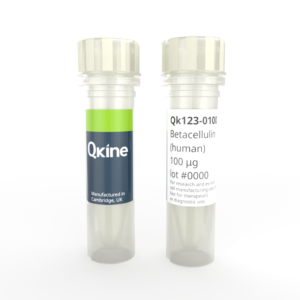
 Recombinant human betacellulin (Qk123)
 Price range: £190.00 through £2,530.00View product
Price range: £190.00 through £2,530.00


Betacellulin is a member of the epidermal growth factor (EGF) family which regulates proliferation and differentiation in various stem cell types. Betacellulin stimulates proliferation and maintains pluripotency in neural and osteogenic stem cells. It can induce pancreatic β-cell differentiation in human embryonic stem cells (ESC) and differentiation of retinal progenitor cells.
Qkine human betacellulin is a highly pure and bioactive 9.89 kDa protein, animal origin-free (AOF), carrier-free, tag-free, and non-glycosylated to ensure its purity with exceptional lot-to-lot consistency.
This protein is also available as GMP compliant Cell Therapy Grade, to enquire email [email protected].
In stock
Orders are typically shipped same or next day (except Friday).
Easy world-wide ordering, direct or through our distributors.
Price range: £190.00 through £2,530.00
Buy online with secure credit card or purchase order. For any questions, please email [email protected]
>98%, by SDS-PAGE quantitative densitometry
Expressed in E. coli
Animal origin-free (AOF) and carrier protein-free
Manufactured in our Cambridge, UK laboratories
Lyophilized from acetonitrile
Cellular proliferation, migration and survival
Stimulation of angiogenesis and vascular network development
Neurogenesis and neural differentiation
Differentiation of retinal progenitor cells
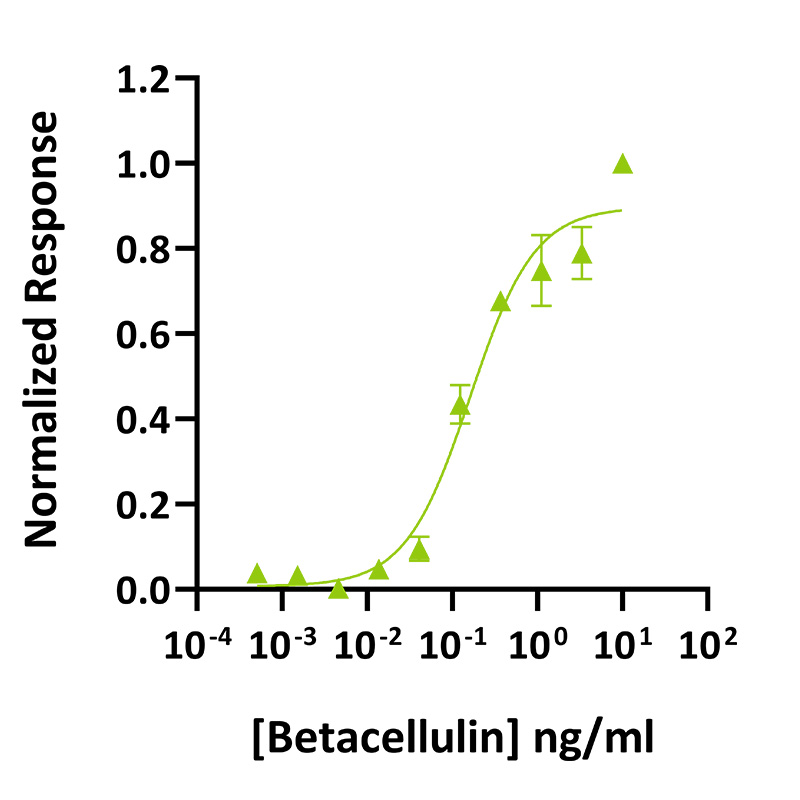
Recombinant betacellulin activity was determined using a luciferase assay. HEK293T cells were treated in triplicate with a serial dilution of betacellulin for 3 hours. Firefly activity was measured and normalized to the control Renilla luciferase activity. Data from Qk123 lot #204720. EC50 = 162.4 pg/ml.
Recombinant betacellulin migrates as a major band at approximately 15 kDa (monomer) in reduced (R) and non-reduced (NR) conditions. No contaminating protein bands are present. The purified recombinant protein 3 µg was resolved using 15% w/v SDS-PAGE in reduced (+β-mercaptoethanol, R) and non-reduced (NR) conditions and stained with Coomassie Brilliant Blue R250. Data from Qk123 lot #204740.
Mass spectrometry: single species with expected mass
Recovery from stock vial: >95%
Endotoxin: <0.05 EU/μg protein
We are a company founded and run by scientists to provide a service and support innovation in stem cell biology and regenerative medicine. All our products are exceptionally high purity, with complete characterisation and bioactivity analysis on every lot.
Betacellulin was originally identified in conditioned media from mouse pancreatic-cell tumor cell line as a proliferation factor. It was discovered to be a member of the epidermal growth factor (EGF) family, binding the EGF receptor (EGF) [1, 2]. The BTC gene encodes a 178 amino acid precursor protein which is membrane anchored and cleaved to produce an 80 amino acid mature form. In addition to the EGFR, betacellulin is also a ligand for ERBB receptors, leading to activation of many intracellular signaling pathways including p38MAPK, PI3K/AKT, and JNK [1].
Initially identified as a pancreatic growth factor, betacellulin stimulates neogenesis and proliferation of pancreatic β-cells [1, 3], and pancreatic tumor cell lines [2]. It is able to covert selected non-β-cells into cells insulin producing cells, including mesenchymal stem cells (MSCs) [1, 5]. Betacellulin may also have a role in angiogenesis, it is detected in some models of retinal neovascularization and induces retinal vascular permeability and edema [1].
Betacellulin has been shown to have a regenerative role in the neural stem cell niche, stimulating proliferation and neurogenesis [5, 6]. In retinal progenitor cells (RPCs) betacellulin promotes proliferation and differentiation into retinal neurons [6]. However, in MSCs and pre-osteoblast cells it may increase proliferation but decrease osteogenic markers [7].
Betacellulin (BTC) is a mitogen belonging to the EGF family.
Betacellulin has tissue dependent effects and is expressed by neuronal, pancreas, small intestine, liver, colon, heart, lung, and mammary glands, as well as skin and esophagus.
Yes, betacellulin is considered a cytokine.
The BTC gene codes for betacellulin, an epidermal growth factor (EGF) family member.
Betacellulin binds to the ErbB receptor family, including ErbB-1 (EGFR) and ErbB-4.
Betacellulin binds to and activates EGFR (ErbB1) and ErbB4 cell surface receptors. EGF receptors activate the Ras/Raf/MAPK and PI3K/Akt pathways to promote cell survival, proliferation, and migration.
Betacellulin binding activates the Ras/Raf/MAPK and PI3K/Akt pathways to promote cell survival, proliferation, and migration.
Betacellulin activity in cell culture is cell type dependent, in some neural and osteogenic cells it can be used to maintain pluripotency, whilst it can be used in the differentiation of other cell types, such as retinal progenitors and pancreatic cells.
Our products are for research use only and not for diagnostic or therapeutic use. Products are not for resale.
For use in manufacturing of cellular or gene therapy products. Not intended for in vivo applications.

£100, $140 or €120 Qkine gift card for product reviews with an image and £50, $70 or €60 for reviews without an image.
Recombinant human betacellulin (Qk123)