
Thermostable FGF2-G3 supports muscle stem cell expansion at ten-fold lower concentration in fully animal-free, chemically-defined conditions
A collaborative study between Media City Scientific and Qkine
Introduction
Skeletal muscle stem cells (MuSCs), also known as satellite cells, are among the most challenging primary cell types to culture ex vivo. MuSCs exist in a deeply quiescent state in vivo and are exquisitely sensitive to their culture environment. Upon isolation, they rapidly activate and begin to differentiate. Maintaining the self-renewal capacity required for meaningful expansion without triggering terminal differentiation demands precise control over media composition and growth factor delivery [1].
Fibroblast growth factor 2 (FGF-2, basic FGF) is a critical mitogen for MuSC proliferation and self-renewal. However, standard recombinant FGF-2 is thermolabile under standard culture conditions, losing ~65% of its activity within 3 hours and ~80% within 24 hours at 37°C [2]. This instability means that high working concentrations are required to maintain effective levels throughout a feeding interval, which becomes a practical and economic challenge when scaling MuSC culture. It also drives frequent medium changes that can themselves destabilize these sensitive cultures.
Qkine manufactures animal origin free, thermostable variants of FGF-2 (FGF2-G3), which retain substantially greater bioactivity at physiological temperatures, with a half-life of >7 days at 37°C [3]. FRS™ Pioneer (Media City Scientific) is a fully chemically defined, animal-origin-free serum replacement formulated for broad cell type compatibility and lot-to-lot consistency. While FRS Pioneer is conventionally used for 100% replacement of FBS for the culture of standard immortalized cell lines, here we evaluate FRS™ Pioneer supplemented with Qkine growth factors as a serum replacement for MuSC culture. We compare the performance of standard FGF-2 and thermostable FGF2-G3, demonstrating equivalent expansion at a ten-fold reduction in working concentration of the thermostable variants.
Methods
Culture conditions
MuSCs were thawed into FBS-containing medium. After 24 hours, cells were directly adapted into DMEM/F12 supplemented with one of six conditions: (1) no supplement; (2) 20% FRS™ Pioneer; (3) 19% FRS™ Pioneer + 1% FBS; (4) 20% FBS; (5) 20% FRS™ Pioneer + 2 ng/ml TGF-β1 (Qk010) + 50 ng/ml FGF-2 (Qk025 or Qk027); or (6) 20% FRS™ Pioneer + 2 ng/ml TGF-β1 (Qk010) + 5 ng/ml FGF2-G3 (Qk052 or Qk053). Cells were maintained across three passages over 11 days.
Adhesion strategy
MuSCs do not produce sufficient endogenous ECM for conditioned-medium surface conditioning. Standard TC-treated plates were pre-coated with 0.5 µg/cm² recombinant vitronectin (Qk120) for 2 hours at 37°C prior to seeding in all conditions.
Primary cells are inherently variable between donors and isolates; the conditions described here represent a validated starting point, and minor optimization of growth factor concentrations or seeding density may be beneficial for specific cell sources.
Results
FRS™ Pioneer supplemented with growth factors supports MuSC expansion comparable to FBS
MuSCs cultured in 20% FRS™ Pioneer supplemented with TGF-β1 and either standard FGF-2 or thermostable FGF2-G3 achieved cumulative population doublings comparable to the 20% FBS positive control over 11 days and three passages. 18% FRS™ Pioneer / 2% FBS hybrid condition also performed comparably to the FBS control.
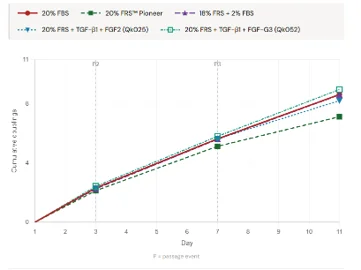
Figure 1. Cumulative population doublings of skeletal muscle stem cells at day 11. Defined medium (FRS™ Pioneer + TGF-β1 + FGF-2 or FGF2-G3) achieved expansion equivalent to the 20% FBS control. Basal media alone failed to sustain MuSC proliferation past 72 hours. Dashed vertical lines indicate passage events. Points indicate measured values; lines represent interpolated growth between passage events. GFs: 2 ng/ml TGF-β1 + 50 ng/ml FGF-2 (Qk025) or 5ng/ml FGF2-G3 (Qk052).
FGF2-G3 delivers equivalent expansion at 10x lower concentration
The standout finding of this study is the concentration advantage of thermostable FGF2-G3. Equivalent MuSC expansion was achieved with 5 ng/ml FGF2-G3 compared to 50 ng/ml standard FGF-2 — a ten-fold reduction in working concentration. This advantage arises from the enhanced thermal stability of FGF2-G3: whereas standard FGF-2 degrades substantially within hours at 37°C, FGF2-G3 retains bioactivity throughout the feeding interval.
At the practical level, this means effective FGF-2 exposure between feeds is far more consistent when using FGF2-G3, reducing the need for frequent medium changes to maintain mitogenic signal. For MuSC culture — where frequent disturbance can itself trigger differentiation — this improved stability has implications for protocol design as well as reagent cost.
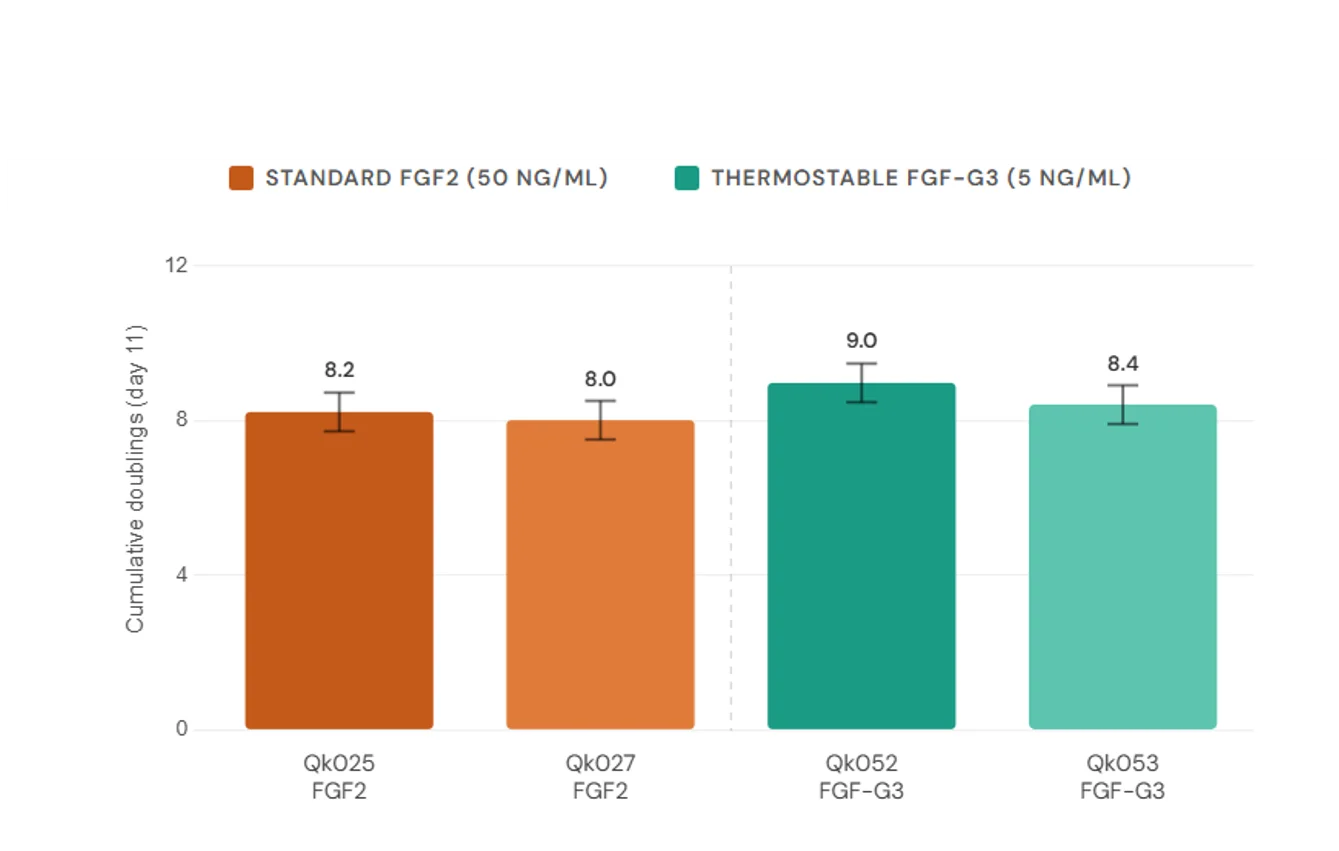
Figure 2. Thermostable FGF2-G3 delivers equivalent performance at a 10x lower concentration in MuSC expansion. Cumulative population doublings of primary muscle stem cells (MuSCs) at day 11 comparing four growth factor formulations within the 20% FRS™ Pioneer culture system. All conditions supplemented with 2 ng/ml TGF-β1 (Qk010). Standard FGF-2 conditions: Qk025 (dark orange) and Qk027 (light orange), each at 50 ng/ml. Thermostable FGF-G3 conditions: Qk052 (dark teal) and Qk053 (light teal), each at 5 ng/ml. FGF-G3 at 5 ng/ml delivers equivalent or superior expansion to standard FGF-2 at 50 ng/ml. Data from a single experiment; n = 3.
Isoform comparison: 145 aa FGF2-G3 and 154 aa FGF2-G3
Among the thermostable variants, the 145 aa isoform of FGF2-G3 (Qk052) may drive slightly increased MuSC proliferation relative to the 154 aa variant (Qk053) at the same 5 ng/ml concentration. This trend is consistent with previously published data from collaborative work between Qkine and the University of Turin [4]. While the difference was modest, it may be worth considering for applications where maximizing expansion yield is the primary objective.
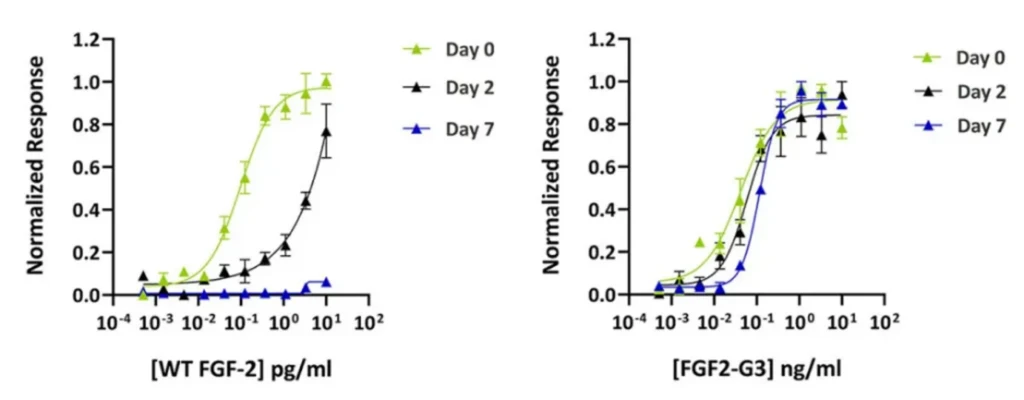
Figure 3. Thermostable FGF2-G3 145 aa maintains bioactivity for >7 days under cell culture conditions. Bioactivity was determined using the Promega serum response element luciferase reporter assay in transfected HEK293T cells. FGF2-G3 145 aa or WT FGF-2 154 aa (Qk027) were incubated in media at 37°C for 0, 2 or 7 days then cells were treated in triplicate with a serial dilution for 3 hours. Firefly luciferase activity was measured and normalized to the control Renilla luciferase activity.
Conclusion
FRS™ Pioneer supplemented with TGF-β1 and FGF-2 supports MuSC expansion equivalent to FBS over 11 days without the batch variability inherent to serum-supplemented culture. The thermostable FGF2-G3 variants deliver equivalent proliferative performance at one-tenth the working concentration of standard FGF-2. This finding has direct implications for reagent cost, protocol frequency, and the practical feasibility of scaled MuSC culture.
Together, these results support a defined, animal-origin-free culture system for muscle stem cells that is both biologically effective and practically optimized for scale, with potential applications in muscle disease research, cell therapy, and cultivated meat production.
Further information
Media City Scientific
Media City Scientific manufactures FRS™ Pioneer, a fully chemically defined, animal-origin-free serum replacement engineered for broad primary cell type compatibility and lot-to-lot consistency. FRS™ Pioneer is available directly and through Qkine.
Qkine
Qkine are committed to raising the standards of growth factors, cytokines and related proteins to better support long-term and complex stem cell culture.
Enquiries: [email protected] | [email protected]
References
[1] Brack AS, Rando TA. Tissue-specific stem cells: lessons from the skeletal muscle satellite cell. Cell Stem Cell. 2012 May 4;10(5):504-14. doi: 10.1016/j.stem.2012.04.001
[2] Chen G, Gulbranson DR, Yu P, Hou Z, Thomson JA. Thermal stability of fibroblast growth factor protein is a determinant factor in regulating self-renewal, differentiation, and reprogramming in human pluripotent stem cells. Stem Cells. 2012 Apr;30(4):623-30. doi: 10.1002/stem.1021
[3] Dvorak P, Bednar D, Vanacek P, et al. Computer-assisted engineering of hyperstable fibroblast growth factor 2. Biotechnology and Bioengineering. 2018; 115: 850–862. doi.org/10.1002/bit.26531
[4] Truszkowski L, Bottini S, Bianchi S, et al. Refined and benchmarked homemade media for cost-effective, weekend-free human pluripotent stem cell culture. Open Res Europe. 2025; 4:192. doi.10.12688/openreseurope.18245.2
All our recombinant proteins are animal-free and come with Bioactivity. Guaranteed.
Contact us
Our science team is here to help, please contact us if you have any questions.