
FRS™ Pioneer: A broad-spectrum, chemically defined and animal-free serum replacement for primary cell culture
A collaborative study between Media City Scientific and Qkine
Introduction
Transitioning primary cell culture away from fetal bovine serum (FBS) and towards defined, animal-origin-free alternatives is an active requirement for scientists developing cell-based therapies, scaling reproducible research platforms, and preparing for regulatory submissions. Yet for demanding primary cell types, chemically defined culture has remained stubbornly difficult. Commercial defined media are typically cell-type-specific, require significant optimization investment, and remain financially inaccessible to earlier-stage research groups [1, 2]. The problem with FBS is even larger than ethics or regulatory control. FBS is an unreliable baseline: lot-to-lot variability means even a well-optimized protocol can fail following a batch switch [3].
FRS™ Pioneer (Media City Scientific) is a fully chemically defined, animal-origin-free serum replacement formulated for broad cell type compatibility and lot-to-lot consistency. Qkine manufactures high-purity, animal-origin-free recombinant growth factors and cytokines. While FRS Pioneer is conventionally used for 100% replacement of FBS for the culture of standard immortalized cell lines, here we evaluate FRS™ Pioneer across four primary cell types, including canine adipose-derived mesenchymal stem cells (AD-MSCs), chondrocytes, primary dermal fibroblasts, and skeletal muscle stem cells (MuSCs), used both as a 90% reduction strategy (9% FRS™ Pioneer + 1% FBS) and as a complete serum replacement supplemented with cell-type-optimized Qkine growth factors.
Methods
Culture conditions
Cells were thawed into their standard FBS-containing medium. After 24 hours, cells were directly adapted into DMEM/F12 basal medium supplemented with one of five conditions: (1) no supplement; (2) 10% FRS™ Pioneer; (3) 9% FRS™ Pioneer + 1% FBS; (4) 10% FBS; or (5) 10% FRS™ Pioneer with cell-type-specific Qkine growth factors (see below). For MuSCs, FBS or FRS™ fractions were doubled to a total of 20%.
Adhesion strategy
For ECM-producing cell types (AD-MSCs, chondrocytes, fibroblasts), 50% conditioned medium from the preceding passage was retained and combined with 50% fresh medium at each re-seed, exploiting endogenous ECM production to establish a self-conditioned surface. Alternatively, plates were pre-coated for 2 hours at 37°C with 1.25 µg/cm² GECKO™ (Media City Scientific). For muscle stem cells, plates were pre-coated with 0.5 µg/cm² recombinant vitronectin (Qkine; Qk120) for 2 hours at 37°C prior to seeding.
Cell type-specific growth factor conditions
- AD-MSCs: 10 ng/ml FGF-2 (Qk025) + 10 ng/ml PDGF-BB (Qk044).
- Chondrocytes: 10 ng/ml FGF-2 (Qk025) + 1 ng/ml TGF-β1 (Qk010).
- Fibroblasts: 10 ng/ml FGF-2 (Qk025) + 5 ng/ml PDGF-BB (Qk044).
- MuSCs: 2 ng/ml TGF-β1 (Qk010) + 50 ng/ml FGF-2 (Qk025).
Primary cells are inherently variable between donors and isolates; the conditions described here represent a validated starting point. Optimization of growth factor concentrations or coating conditions may be beneficial for specific cell sources.
Results
FRS™ Pioneer reduces FBS by 90%, while delivering near-FBS performance across all cell types
The 9% FRS™ Pioneer / 1% FBS hybrid condition delivered expansion at or near the FBS positive control across all four primary cell types tested. This hybrid approach requires no additional protocol optimization and provides an immediately accessible entry point for any laboratory wishing to reduce serum dependence while protecting against batch variability.
FRS™ Pioneer is fully animal-free and chemically defined, meaning it is 100% consistent from lot to lot. The variability remaining from the 1% retained FBS is substantially diluted compared to normal serum-containing conditions, making this a practical transition strategy to hedge against FBS batch variability while more comprehensive serum-free optimization is undertaken.
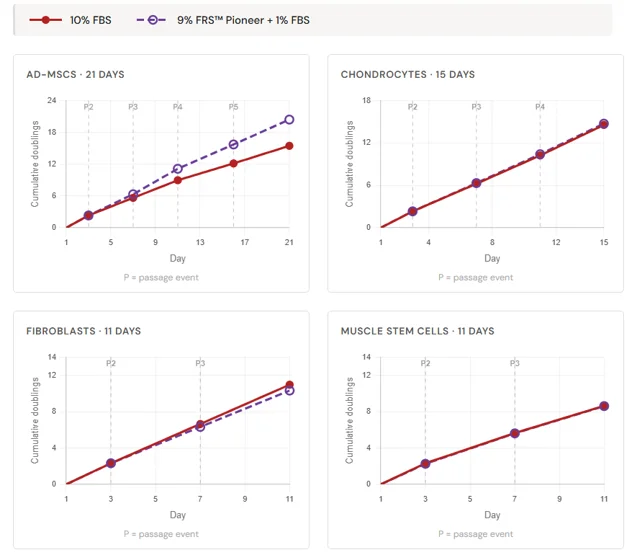
Figure 1. Cumulative population doublings across four primary cell types under the 9% FRS™ Pioneer / 1% FBS hybrid condition versus FBS control. AD-MSCs cultured for 21 days (5 passages); chondrocytes for 15 days (4 passages); fibroblasts for 11 days (3 passages); MuSCs for 11 days (3 passages). Note: MuSCs were grown with 20% supplementation (20% FBS or combined 18% FRS + 2% FBS). Dashed vertical lines indicate passage events. Points indicate measured values; lines represent interpolated growth between passage events.
Full serum replacement with Qkine growth factors
When FRS™ Pioneer is supplemented with cell-type-specific Qkine growth factors, complete serum replacement is achievable across multiple primary cell types. AD-MSCs in fully defined medium achieved approximately 30% greater expansion than the FBS control over 21 days. Chondrocytes in defined medium matched FBS performance while maintaining chondrogenic morphology. MuSC expansion was equivalent to the FBS control. Fibroblasts achieved approximately 80% of FBS performance under fully defined conditions, with morphology suggesting an adhesion optimization requirement rather than an intrinsic nutritional limitation of the defined medium.
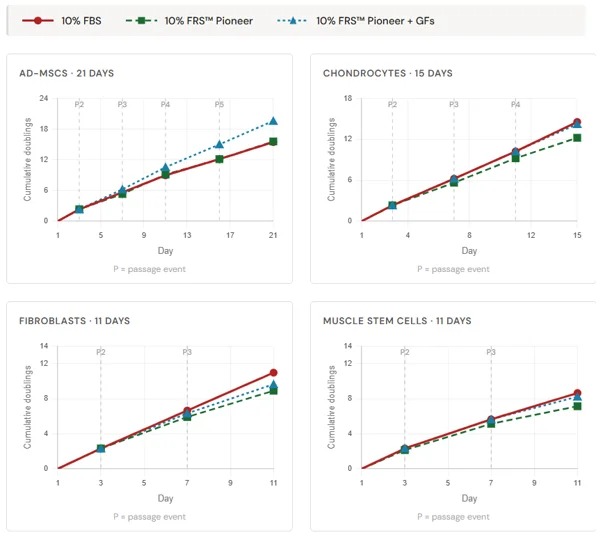
Figure 2. Cumulative population doublings over time across four primary cell types under fully defined serum-free conditions. GFs: AD-MSCs: 10 ng/ml PDGF-BB + 10 ng/ml FGF-2; Chondrocytes: 10 ng/ml FGF-2 + 1 ng/ml TGF-β1; Fibroblasts: 10 ng/ml FGF-2 + 10 ng/ml PDGF-BB; MuSCs: 2 ng/ml TGF-β1 + 50 ng/ml FGF-2. Note the muscle stem cells were grown with 20% supplementation (FBS or FRS Pioneer). Dashed vertical lines indicate passage events. Points indicate measured values; lines represent interpolated growth between passage events. Basal media alone failed to support proliferation of any cell type beyond 72 h.
Conclusion
FRS™ Pioneer, used as a 90% serum reduction strategy with 1-2% FBS, delivers near-FBS performance across a panel of demanding primary cell types with no protocol modifications required. When paired with cell-type-optimized Qkine growth factors, full serum replacement is achievable with performance matching or exceeding FBS in three of four cell types tested. These results establish FRS™ Pioneer as a broadly applicable, chemically defined alternative to FBS that is immediately practical for research laboratories and positioned for regulatory compliance in advanced therapy manufacturing.
Further information
Media City Scientific
Media City Scientific manufactures FRS™ Pioneer, a fully chemically defined, animal-origin-free serum replacement engineered for broad primary cell type compatibility and lot-to-lot consistency. FRS™ Pioneer is available directly and through Qkine.
Qkine
Qkine are committed to raising the standards of growth factors, cytokines and related proteins to better support long-term and complex stem cell culture.
Enquiries: [email protected] | [email protected]
References
[1] Kolkmann AM, Van Essen A, Post MJ, et. al. Development of a Chemically Defined Medium for in vitro Expansion of Primary Bovine Satellite Cells. Front Bioeng Biotechnol. 2022 4;10:895289. doi: 10.3389/fbioe.2022.895289.
[2] Chelladurai KS, Durairaj J, Christyraj S, et. al. Alternative to FBS in animal cell culture – An overview and future perspective. Heliyon. 2021 7;8: e07686. Doi: 10.1016/j.heliyon.2021.e07686.
[3] Stival ACS, Garcia da Silva AC, Valadares MC, Qualitative and quantitative evaluation of Fetal Bovine Serum composition: toward ethical and best quality in vitro science. NAM Journal. 2025 1:100047. doi: 10.1016/j.namjnl.2025.100047.
All our recombinant proteins are animal-free and come with Bioactivity. Guaranteed.
Contact us
Our science team is here to help, please contact us if you have any questions.