
 Recombinant human Flt3L protein (Qk087-CTG)
Price range: £3,795.00 through £5,940.00View product
Price range: £3,795.00 through £5,940.00


Fms-like tyrosine kinase 3 ligand (Flt-3 Ligand or Flt3L) is a cytokine that is involved in the regulation of hematopoiesis. It stimulates the survival, proliferation, and differentiation of various early myeloid and lymphoid progenitor cells. Flt3L is commonly used in the differentiation of hematopoietic stem cells into dendritic cells.
Human recombinant Flt3L has a molecular weight of 17.6 kDa. This cell therapy grade protein is animal origin-free, carrier protein-free, tag-free, and non-glycosylated to ensure a homogenous population with exceptional lot-to-lot consistency.
Qkine cell therapy grade high purity animal origin-free proteins are manufactured as GMP grade equivalents in an ISO 9001:2015-certified facility, under ISO 20399:2022 standards with GMP compliance, defined quality criteria and documentation.
This product is available to order now and will be in stock soon, please contact us for the estimated lead time [email protected]
In stock
Orders are typically shipped same or next day (except Friday).
Easy world-wide ordering, direct or through our distributors.
Price range: £3,795.00 through £5,940.00
Buy online with secure credit card or purchase order. For any questions, please email [email protected]
Certified animal origin-free (AOF)
Cell and gene therapy grade
Manufactured in our ISO 9001:2015 facility in Cambridge, UK
Lot-to-lot consistency in bioactivity
Full traceability and documentation
Carrier protein-free, tag free
Expressed in E. coli
Lyophilized from Tris
Generation of iPSC-derived dendritic cells
Immune cell therapy expansion
CAR-T cell therapy manufacturing
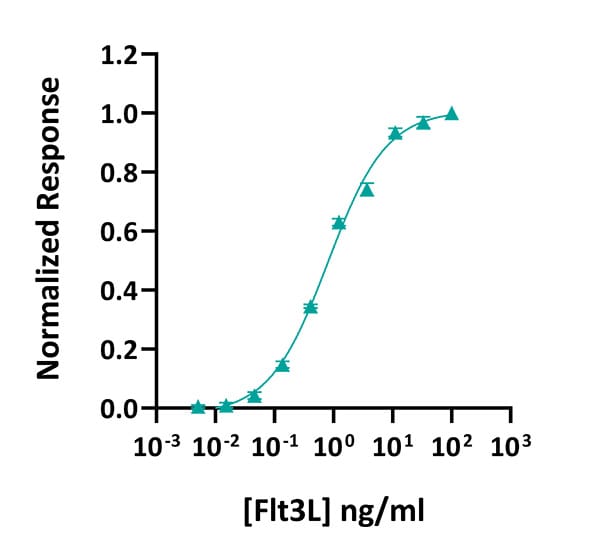
Flt3L activity was determined using proliferation of AML5 human myeloid leukemia cells. Cells were treated in triplicate with a serial dilution of Flt3L for 72 hours. Cell viability was measured using the CellTiter-Glo Cell Proliferation Assay (Promega). Data from Qk087-CTG lot #204783. EC50 = 0.80 ng/ml (45 pM).
The specific activity of recombinant cell therapy grade Flt3L is >0.6 x 10⁶ IU/mg, which is calibrated against the human Flt3L standard (NIBSC code: 96/532).
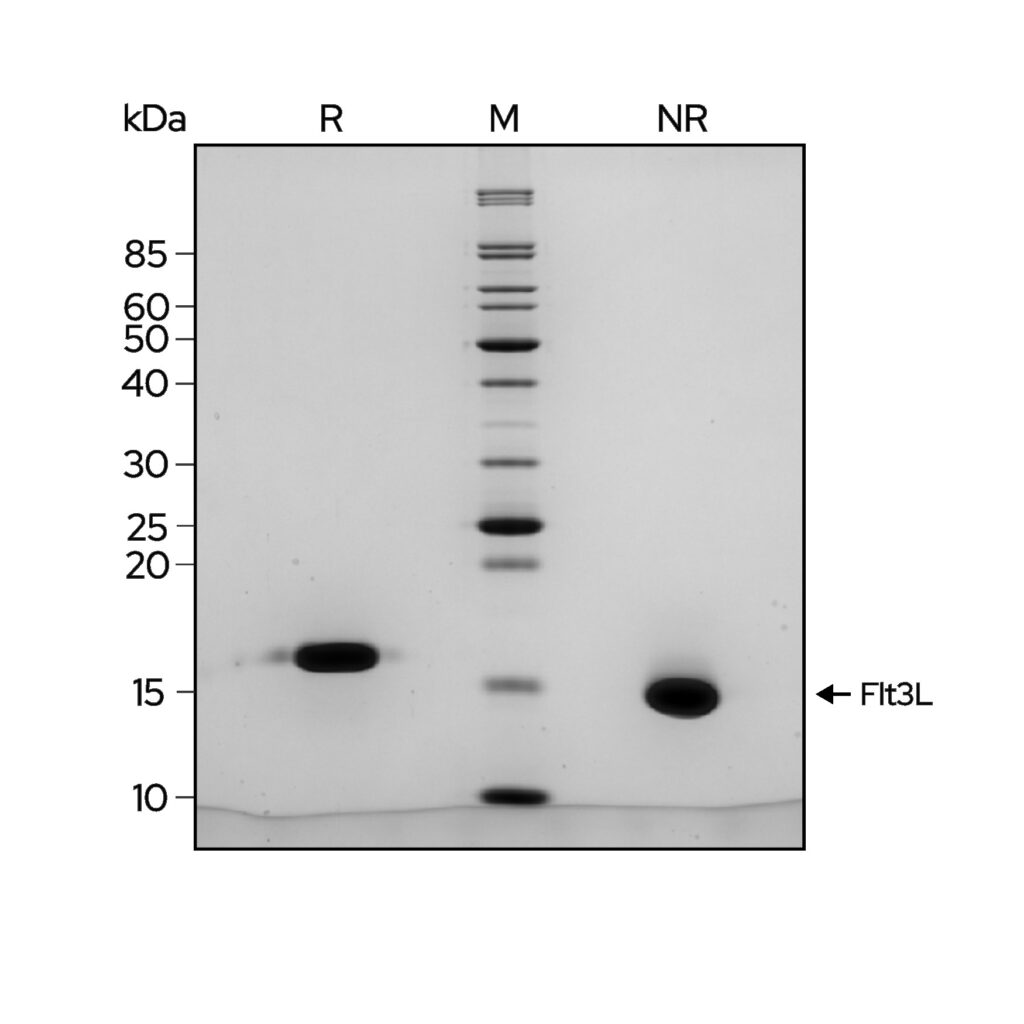
Recombinant Flt3L migrates as a major band at approximately 17.6 kDa in non-reducing (NR) ad reduced (R) conditions. No contaminating protein bands are present. The purified recombinant protein (3 µg) was resolved using 15% w/v SDS-PAGE in reduced (+β-mercaptoethanol, R) and non-reduced conditions and stained with Coomassie Brilliant Blue R250. Data from Qk087 lot #204566.
Mass spectrometry: single species with expected mass
Purity >98%, by SDS-PAGE quantitative densitometry
Recovery from stock vial: >95%
Sterility tested and mycoplasma negative
Endotoxin: <0.05 EU/μg protein
Residual host cell protein <10 ng/µg
Residual host cell DNA <10 ng/μg
N-terminal sequence analysis
We are a company founded and run by scientists to provide a service and support innovation in stem cell biology and regenerative medicine. All our products are exceptionally high purity, with complete characterisation and bioactivity analysis on every lot.
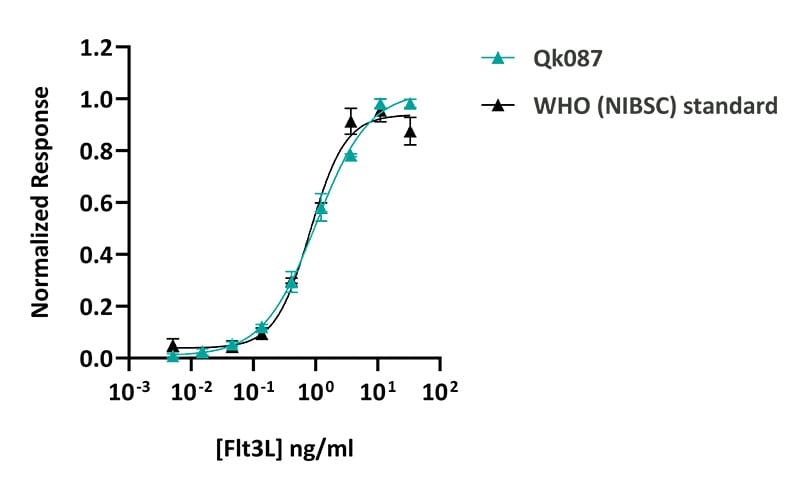
Qkine Flt3L was as bioactive as the WHO (NIBSC) standard Flt3L. Flt3L activity was determined using proliferation of AML5 human myeloid leukemia cells. Cells were treated in triplicate with a serial dilution of Flt3L for 72 hours. Cell viability was measured using the CellTiter-Glo Cell Proliferation Assay (Promega). Qk087 #204566 EC50 = 1.02 ng/ml, WHO (NIBSC) EC50 = 0.82 ng/ml.
Fms-like tyrosine kinase 3 ligand (Flt-3 Ligand or Flt3L) is a cytokine that is involved in the regulation of hematopoiesis [1–3]. Along with other cytokines, Flt3L stimulates the survival, proliferation, and differentiation of various early myeloid and lymphoid progenitor cells including dendritic cells, NK cells, and B cells [4–6]. Flt3L is indispensable in the differentiation of hematopoietic stem cells to the dendritic cell lineage and is crucial in the initiation of antigen presentation and the development of immune response.
Flt3L is a homodimer of two short chain α-helical bundles [8]. It is released by stromal cells of the bone marrow and thymus such as osteoblasts, fibroblasts, endothelial and perivascular cells [9]. Flt3L specifically interacts with the Flt3 receptor (Flt3/Flk-2), a type III tyrosine kinase receptor expressed on the surface of hematopoietic stem cells, early myeloid and lymphoid progenitor cells, and dendritic cells [10]. Binding to Flt3 triggers the STAT3 signaling cascade [4].
Flt3L is commonly used in cell culture to support the expansion and differentiation of hematopoietic stem cells, particularly to dendritic cells. Flt3L can differentiate induced pluripotent stem cells or peripheral blood monocytes into dendritic cells [4,11]. It acts synergistically with GM-CSF to enhance the proliferation of myeloid progenitors and can further influence the specificity of pre-dendritic cells with other lineage instructive cytokines [12].
The role of Flt3L in promoting the development of dendritic cells and influencing the immune system makes it a target of interest in various therapeutic applications, particularly in the context of immunotherapy and hematopoietic stem cell mobilization [7]. Flt3L has been investigated for its ability to enhance immune responses against cancer and infectious diseases using engineered T cell receptors or CAR T cells [13]. Additionally, it has been studied for its potential to mobilize hematopoietic stem cells, which could be beneficial for certain medical procedures like stem cell transplantation.
[1] Gilliland, D. G. & Griffin, J. D. The roles of FLT3 in hematopoiesis and leukemia. Blood 100, 1532–1542 (2002). doi: 10.1182/blood-2002-02-0492
[2] McKenna, H. J. et al. Mice lacking flt3 ligand have deficient hematopoiesis affecting hematopoietic progenitor cells, dendritic cells, and natural killer cells. Blood 95, 3489–3497 (2000). PMID: 10828034
[3] Gabbianelli, M. et al. Multi-level effects of flt3 ligand on human hematopoiesis: expansion of putative stem cells and proliferation of granulomonocytic progenitors/monocytic precursors. Blood 86, 1661–1670 (1995). PMID: 7544638
[4] Laouar, Y., Welte, T., Fu, X.-Y. & Flavell, R. A. STAT3 Is Required for Flt3L-Dependent Dendritic Cell Differentiation. Immunity 19, 903–912 (2003). doi: 10.1016/s1074-7613(03)00332-7
[5] Ray, R. J., Paige, C. J., Furlonger, C., Lyman, S. D. & Rottapel, R. Flt3 ligand supports the differentiation of early B cell progenitors in the presence of interleukin-11 and interleukin-7. Eur. J. Immunol. 26, 1504–1510 (1996). doi: 10.1002/eji.1830260715
[6] Yu, H. et al. Flt3 Ligand Promotes the Generation of a Distinct CD34+Human Natural Killer Cell Progenitor That Responds to Interleukin-15. Blood 92, 3647–3657 (1998). PMID: 9808558
[7] Cueto, F. J. & Sancho, D. The Flt3L/Flt3 Axis in Dendritic Cell Biology and Cancer Immunotherapy. Cancers 13, 1525 (2021). doi: 10.3390/cancers13071525
[8] Savvides, S. N., Boone, T. & Andrew Karplus, P. Flt3 ligand structure and unexpected commonalities of helical bundles and cystine knots. Nat. Struct. Biol. 7, 486–491 (2000). doi: 10.1038/75896
[9] Lyman, S. D. & Jacobsen, S. E. W. c-kit Ligand and Flt3 Ligand: Stem/Progenitor Cell Factors With Overlapping Yet Distinct Activities. Blood 91, 1101–1134 (1998). PMID: 9454740
[10] Drexler, H. G. & Quentmeier, H. FLT3: receptor and ligand. Growth Factors Chur Switz. 22, 71–73 (2004). doi: 10.1080/08977190410001700989
[11] Jefford, M. et al. Functional comparison of DCs generated in vivo with Flt3 ligand or in vitro from blood monocytes: differential regulation of function by specific classes of physiologic stimuli. Blood 102, 1753–1763 (2003). doi: 10.1182/blood-2002-12-3854
[12] Xu, Y., Zhan, Y., Lew, A. M., Naik, S. H. & Kershaw, M. H. Differential Development of Murine Dendritic Cells by GM-CSF versus Flt3 Ligand Has Implications for Inflammation and Trafficking1. J. Immunol. 179, 7577–7584 (2007). doi: 10.4049/jimmunol.179.11.7577
[13] Lai, J. et al. Adoptive cellular therapy with T cells expressing the dendritic cell growth factor Flt3L drives epitope spreading and antitumor immunity. Nat. Immunol. 21, 914–926 (2020). doi: 10.1038/s41590-020-0676-7
Moullet M, Isobe T, Vahidi A et al.
DOI: doi.org/10.64898/2026.03.24.713961Paulas-Condori L, Palma A, Consoli L et al.
DOI: doi.org/10.64898/2026.10.07.756550Our products are for research use only and not for diagnostic or therapeutic use. Products are not for resale.
For use in manufacturing of cellular or gene therapy products. Not intended for in vivo applications.

£100, $140 or €120 Qkine gift card for product reviews with an image and £50, $70 or €60 for reviews without an image.
Recombinant human Flt3L protein (Qk087-CTG)